On June 10th, on our way back from Spokane, we stopped at one of our favorite places, Derby Canyon, near Peshastin, Washington. I went to see if I could find the Western Peony in bloom, but we had missed it once again.
Hiking the trail along the ridge we did find a few spikes of Corallorhiza maculata var. occidentalis, the Western Spotted Coralroot and both of us took pictures, my wife, as is so often the case, getting the better shots (the last two are hers).
As we were leaving, somewhat disappointed at not finding the Peony in bloom, I noticed just along the road several clumps of the mountain Lady's Slipper, and so no longer disappointed, we parked the car once again and spent some additional time photographing them.
A photographic record of the beautiful and often rare native orchids that can be found in our area.
Tuesday, July 5, 2011
Monday, July 4, 2011
Corallorhiza mertensiana at Hoypus Hill.
Corallorhiza mertensiana, the Western Coralroot, has the most delicate flowers of the Coralroots native to the Pacific Northwest. They look like tiny purple (or green) birds in flight, and because they are so fine and tiny they are often overlooked.
We visited Deception Pass State Park on Whidbey Island June 4th and again on June 12th to see them. We found both the yellow-stemmed and purple-stemmed varieties and found them in abundance in the locations where we looked for them.
They are interesting in that they are almost always found in very dry locations under rather heavy forest cover with almost no other surrounding vegetation. They grow through the litter of dead branches and twigs on the forest floor and receive only a minimum of sunlight.
Because they are saprophytic they do not need the sunlight to produce their food through photosynthesis, but it is nevertheless always a bit surprising to find them where nothing else seems to grow. In the shade their purple color almost glows.
Friday, June 3, 2011
Calypso bulbosa in the Columbia Gorge
Hiking in the Columbia Gorge in the area of Horsetail Falls we found the Western Fairy Slipper (Calypso bulbosa var. occidentalis) growing in various locations along the trail. Interestingly, in the steeper areas it seemed always to be on the northwest corner of the outcrops. We saw it so often in that location that we began to look for it there and found it in places we had previously missed.
In those locations they were often half hidden under other vegetation (and thus known as the "Hider of the North"), but the other location where we found them was different. That location was in an open mixed woodland, quite level where the plants got only a very little bit of sun and where there was almost no other vegetation. It was in that location that we began to find Listera cordata as well though we we tended to find more of it in damper, shadier locations.
Horsetail Falls
Thursday, June 2, 2011
Corallorhiza maculata in Washington Park
I recently put up a post about the Spotted Coralroot, Corallorhiza maculata, but found them again at Washington Park on Fidalgo Island, and found both varieties there, though in different locations. The differences between these two varieties, though, are negligible, and it is sometimes the case that it is difficult to distinguish them from each other. In this cae, though, they seemed fairly different.
The Spotted Coralroot (below), Corallorhiza maculata var. maculata, has a lip which is more or less rectangular. The Western Spotted Coralroot (above), Corallorhiza maculata var. occidentalis, has a lip which is more or less round on the end. Paul Martin Brown says that they are separate in their flowering times, but in this case they were both at the peak of their flowering when I saw them.
The park is on a rocky outcrop of Fidalgo Island and has a one-lane road that runs around its perimeter. I walked the road against traffic (of which there was not much) about a third of the way and then took to the trails t along the cliffs and through the woods on the edge of the park. I found the first variety under the trees along the road on the east side and the second along the trails on the south side.
As can be seen from the pictures there definitely are two different lip shapes, but I really wonder if they are actually different varieties. Perhaps, though, I am just mistaking plants of the Western Spotted Coralroot with a less rounded lip for the other variety, but in that case it seems to me that the two so shade into each other that they do not warrant consideration as separate varieties.
I am not enough of a botanist, however, to know for sure, and certainly enjoyed seeing these unique plants even if my identification is not quite correct. They are remarkable plants, not only for their unusual colors, but also because they often spring up several feet away from where last year's dried flower spikes are still standing, and not always in the same numbers as the previous year.
Corallorhiza maculata on Whidbey Island
On our recent camping trip son Edward and I made a quick side trip to the grounds of the Pacific Rim campus of the Au Sable Institute of Environmental Studies. We went to check on the population of the Ozette Coralroot (Corallorhiza maculata var. ozettensis) that is found on their property, only the second known location for this rare native orchid species, Washington's only endemic orchid.
We found the Ozette Coralroots only just starting to put up their flower spikes, but found the more common variety of the species, the Western Spotted Coralroot (C. maculata var. occidentalis) in full bloom along with the Fairy Slippers (Calypso bulbosa). I had never seen such large clumps of them, nor so many of them in one location before. They were everywhere.
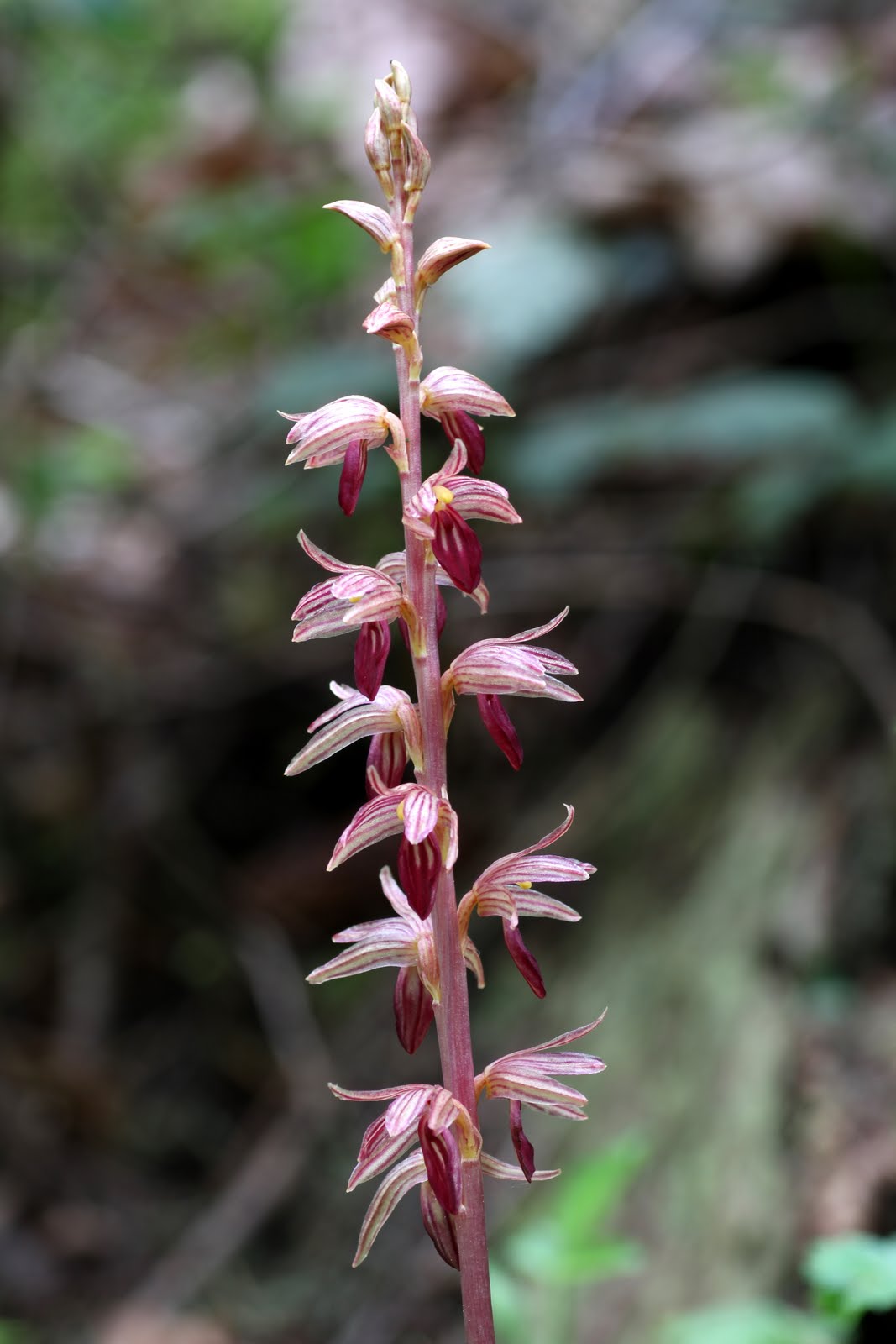
We found them all through the woods, mostly growing as a few spikes in each location, but near the edge of the woods and just a bit away from the road there were hundreds of spikes growing in dense clumps. We had time for a few pictures, somewhat difficult in the fading light and breeze, and the majority of these pictures were taken in that location.
As is evident from the pictures we found both the brown-stemmed and the red-stemmed forms of this species and in one location in the woods we found a single stem whose flowers seemed to be of the other variety, maculata.
For more information on this species check my previous post on this blog which describes this orchid: http://nativeorchidsofthepacificnorthwest.blogspot.com/2010/08/spotted-coralroot-corallorhiza-maculata.html.
Wednesday, May 25, 2011
Neottia cordata in the Columbia Gorge
Neottia cordata, the Heart-leaved Twayblade, is a small, hardly noticeable species of our native orchids. We found it hiking in the Columbia Gorge on May 17th, but found it almost accidentally. We had seen Fairy Slippers (Calypso bulbosa) in various locations along the trail and had stopped in one particularly good location to photograph them when we noticed, while crawling around on the ground, that there were Listeras growing in the same location.
Later as we hiked back down the same trail we saw them everywhere, including the red variety, though we had not seen them going up the trail. We are always watching the plants along the trail, so they must be diminutive indeed for us to have missed them. I've described them more fully in another post on this blog: http://nativeorchidsofthepacificnorthwest.blogspot.com/2010/11/heart-leaved-twayblade-listera-cordata.html, so will not describe them in detail again here.
The plants we saw were all less than six inches tall and that along with their location leads me to believe that they were variety nephrophylla, the Western Heart-leaved Twayblade, the reddish form being variety nephrophylla fma. rubescens. They seemed to grow for the most part as individual plants and not clumps, though always in damper, shadier locations. Interestingly, the red form (shown below) was nearly finished flowering, while the green form was at its peak in most cases.
Later as we hiked back down the same trail we saw them everywhere, including the red variety, though we had not seen them going up the trail. We are always watching the plants along the trail, so they must be diminutive indeed for us to have missed them. I've described them more fully in another post on this blog: http://nativeorchidsofthepacificnorthwest.blogspot.com/2010/11/heart-leaved-twayblade-listera-cordata.html, so will not describe them in detail again here.
The plants we saw were all less than six inches tall and that along with their location leads me to believe that they were variety nephrophylla, the Western Heart-leaved Twayblade, the reddish form being variety nephrophylla fma. rubescens. They seemed to grow for the most part as individual plants and not clumps, though always in damper, shadier locations. Interestingly, the red form (shown below) was nearly finished flowering, while the green form was at its peak in most cases.
Monday, May 23, 2011
Corallorhiza striata in the Chuckanuts
There is a detailed description of this leafless, saprophytic species already on this blog and the photos there came from the same location as the photos here, but I'm posting this with emphasis on habitat and location: http://nativeorchidsofthepacificnorthwest.blogspot.com/2010/08/striped-coralroot-corallorhiza-striata.html.
As the Coralroots go this is one of the smaller species, but also one of the largest flowered species. The plant is only about a foot tall in this location but the flowers are three quarters of an inch in size and very beautifully colored. This is definitely a species worth looking for and one that will be remembered when found.
There are a number of these growing on the edge of the Interurban Trail in the Chuckanuts, south of Bellingham. The trail is heavily used by bikers, walkers and runners, but the plants are far enough off the path itself that they generally escape damage, though I noticed when I was first there that one spike was broken off.
I counted about a dozen single spikes scattered along the trail, most of them half hidden in the surrounding growth and one larger clump of six spikes in a more open and slightly wetter area. There were more spikes last year, but Coralroots are notorious for their unpredictability and I may also have missed some.
These were found and the location passed on to me by my good friend, Marti Anderson whose blog is well worth following: http://meanderingwa.blogspot.com/2010/05/larrabee-state-park.html. I've been to see them twice this spring, but found only just beginning to open the first time.
Subscribe to:
Posts (Atom)