Showing posts with label columbia river. Show all posts

Monday, June 18, 2012

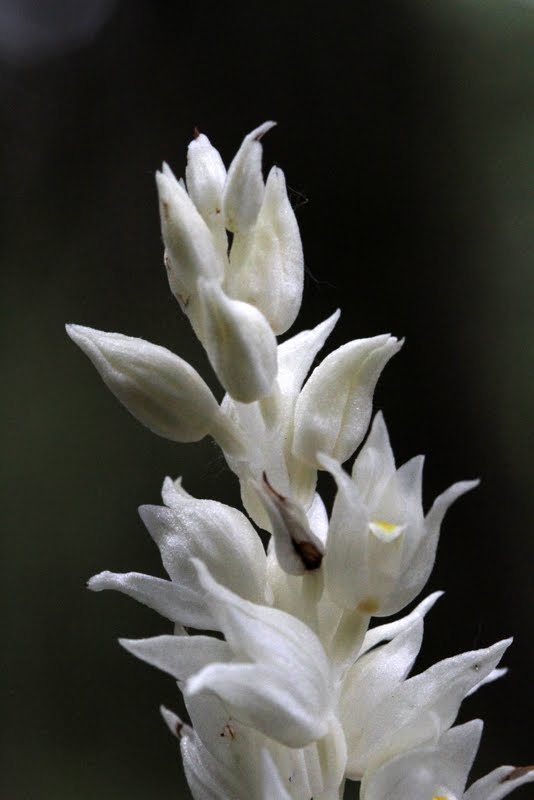
Phantom Orchids in the Columbia River Gorge


June 12th, after visiting our son in the Spokane area, we drove through the night to the Columbia River Gorge and spent the day visiting several sites there, looking for native orchids and enjoying the spectacular scenery of the gorge.  We visited an area near Drano Lake on the Washington side of the gorge belonging to the Forest Service and found three orchids there, including the Phantom Orchids that are the subject of this post.  We thought we had hit the jackpot since there were several hundred Phantom Orchids in bloom there.  After spending some time there we went on to Dog Mountain, still on the Washington side, and even though the weather was not very good, hiked the Dog Mountain Trail there and found Phantom Orchids everywhere.


The Phantom Orchid, Cephalanthera austiniae, is one of our rarer orchids, though we saw plenty of them at these locations.  It is also unique in several ways.  Cephalanthera is primarily a European and Asian genus with only this species in North America.  In the genus this is the only species that is saprophytic (living off decaying material in the soil) and lacking in color (most species are pink to purple in color), and it is the only North American species that is always white.  There are white forms of several other native orchids, but these plants are always a stark white that makes them stand out like phantoms on the dark forests floors where they grow.  Their lack of color also means, of course, that they are without chlorophyll.


Friday, June 3, 2011

Calypso bulbosa in the Columbia Gorge


Hiking in the Columbia Gorge in the area of Horsetail Falls we found the Western Fairy Slipper (Calypso bulbosa var. occidentalis) growing in various locations along the trail.  Interestingly, in the steeper areas it seemed always to be on the northwest corner of the outcrops.  We saw it so often in that location that we began to look for it there and found it in places we had previously missed.


In those locations they were often half hidden under other vegetation (and thus known as the "Hider of the North"), but the other location where we found them was different.  That location was in an open mixed woodland, quite level where the plants got only a very little bit of sun and where there was almost no other vegetation.  It was in that location that we began to find Listera cordata as well though we we tended to find more of it in damper, shadier locations.

Horsetail Falls

Wednesday, May 25, 2011

Neottia cordata in the Columbia Gorge

Neottia cordata, the Heart-leaved Twayblade, is a small, hardly noticeable species of our native orchids.  We found it hiking in the Columbia Gorge on May 17th, but found it almost accidentally.  We had seen Fairy Slippers (Calypso bulbosa) in various locations along the trail and had stopped in one particularly good location to photograph them when we noticed, while crawling around on the ground, that there were Listeras growing in the same location.
Later as we hiked back down the same trail we saw them everywhere, including the red variety, though we had not seen them going up the trail.  We are always watching the plants along the trail, so they must be diminutive indeed for us to have missed them.  I've described them more fully in another post on this blog: http://nativeorchidsofthepacificnorthwest.blogspot.com/2010/11/heart-leaved-twayblade-listera-cordata.html, so will not describe them in detail again here.


The plants we saw were all less than six inches tall and that along with their location leads me to believe that they were variety nephrophylla, the Western Heart-leaved Twayblade, the reddish form being variety nephrophylla fma. rubescens.  They seemed to grow for the most part as individual plants and not clumps, though always in damper, shadier locations.  Interestingly, the red form (shown below) was nearly finished flowering, while the green form was at its peak in most cases.