Showing posts with label larrabee state park. Show all posts

Saturday, May 4, 2013

Fourth Week of the Native Orchid Season - Fairy Slippers, Striped Coralroots and Spotted Coralroots


April 28-May 4

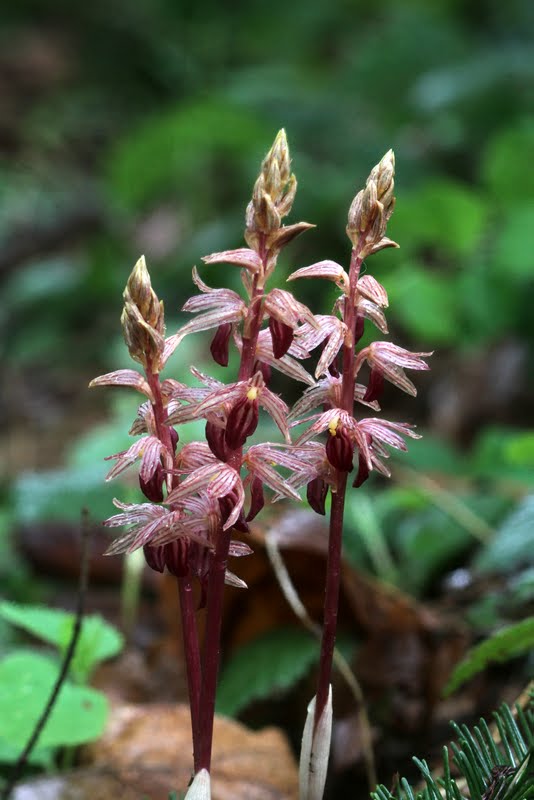
Friday, May 3rd, I visited five different sites on Whidbey and Fidalgo Islands looking for native orchids.  I visited the Au Sable Institute near Coupeville, two locations in Deception Pass State Park, Hoypus Hill and Goose Rock, Washington Park near Anacortes and a site in Larrabee State Park.  Without identifying specific locations, I found three orchids in bloom, the Western Fairy Slipper, Calypso bulbosa var. occidentalis, the Western Spotted Coralroot, Corallorhiza maculata var. occidentalis, and the Striped Coralroot, Corallorhiza striata.  The Fairy Slippers were near the end of their blooming season, the Striped Coralroots were at their peak and the Spotted Coralroots were just starting to bloom.

I also found at one of these locations a white Fairy Slipper, Calypso bulbosa var. occidentalis fma. nivea, and therein lies both a story and the reason why I am no longer publishing locations.  We had found a white Fairy Slipper last spring in Washington Park and I had published the fact that I had found it there.  Whether that was the impetus or not, I do not know, but someone dug it up, as I discovered when I went back to see it this spring.  Thus, both on Flickr and in my blog posts I am no longer going to give specific locations for the orchids I find and will not reveal those locations except to those whom I trust.  The white form of the Fairy Slipper is rare in nature and for someone to dig it up is a crime.

And a note about the Fairy Slipper photos.  First, as to the white Fairy Slipper, there are faint hints of color that show it to be not quite a pure alba form, but the lack of brown color on the front of the lip and the greenish color at the back of the pouch distinguish it from other pale forms, some of which are also shown below.  Second, I tried to show some of the variation in color, both of flowers and lip.  The flowers themselves vary from near-white to dark pink and the lips or pouches have more or less brown spotting.  Finally, because I've already posted so many pictures of this year's Fairy Slippers I've tried to show some of the detail and to be a bit more creative with my shots.

Western Fairy Slipper
Calypso bulbosa var. occidentalis


White Fairy Slipper
Calypso bulbosa var. occidentalis fma. nivea


Striped Coralroot
Corallorhiza striata


Western Spotted Coralroot
Corallorhiza maculata var. occidentali


Saturday, September 1, 2012

Broad-leaved Helleborine at Clayton Beach in Larrabee State Park


Larrabee State Park, which is south of Bellingham, Washington, is situated on the coast, but includes both seashore and "mountains," since it is in an area where the Chuckanut Mountains border the coast.  The Chuckanuts are part of the Cascade Range and are more foothills than mountains, but they are the only part of the Cascade Range that comes down to the sea.  They are also a wonderful place for native orchids.

In this case, however, the orchid we went to see in Larrabee State Park was down near the shore, and even more interestingly, is not a native.  Epipactis helleborine, the Broad-leaved Helleborine, is native to Europe, but has made its way to this country and has naturalized itself all across the northern United States and southern Canada to the extent that it is considered to be nothing but a weed by some folk.


In this case it grows in some abundance along the trail to the Clayton beach area of Larrabee, near a railroad track that runs through the park (one has to cross the tracks to get to the shore).  It is, in fact, most abundant in the brush along the tracks, which makes me wonder if it was not spread or distributed there in some way by the railroad itself, either by construction crews or by the trains as they move through the park.


Whatever its origin in Larrabee, it has spread up the trail from the tracks and into the woods on both sides of the tracks.  It grows there in two color forms, green with a pink lip and purplish with a darker lip, and is quite variable in plant size, number of flowers and flower size.  It is our only non-native orchid and one of only two species belonging to the genus, Epipactis.  The other, quite rare, is the Stream Orchid or Chatterbox, Epipactis gigantea.


Interestingly, when I was there on August 13th the darker flowers were starting to show signs of age, but the lighter flowers were fresh, and there were some that may have been the completely green form that were not yet open.  I intended to go back and see if they were indeed an "alba" form, but due to other pressures never made it back, which only gives me an excuse to go back next year to check on them.

Tuesday, May 15, 2012

Striped Coralroots in Larrabee State Park


On May 3rd my wife and I went to see if the Striped Coralroots were blooming in Larrabee State Park.  The day was rainy and very wet, but we went anyway and found them in full bloom, more of them than we had seen before.  The rain actually made for some interesting pictures of this most beautiful of our native Coralroots.


The Striped Coralroot (Corallorhiza striata var. striata) has the largest flowers of any of our native Coralroots and is also the most beautiful, though far more difficult to find than the Spotted or Western Coralroot.  We have found it in only two locations though we know of a few others, but the Spotted and Western Coralroots are everywhere.