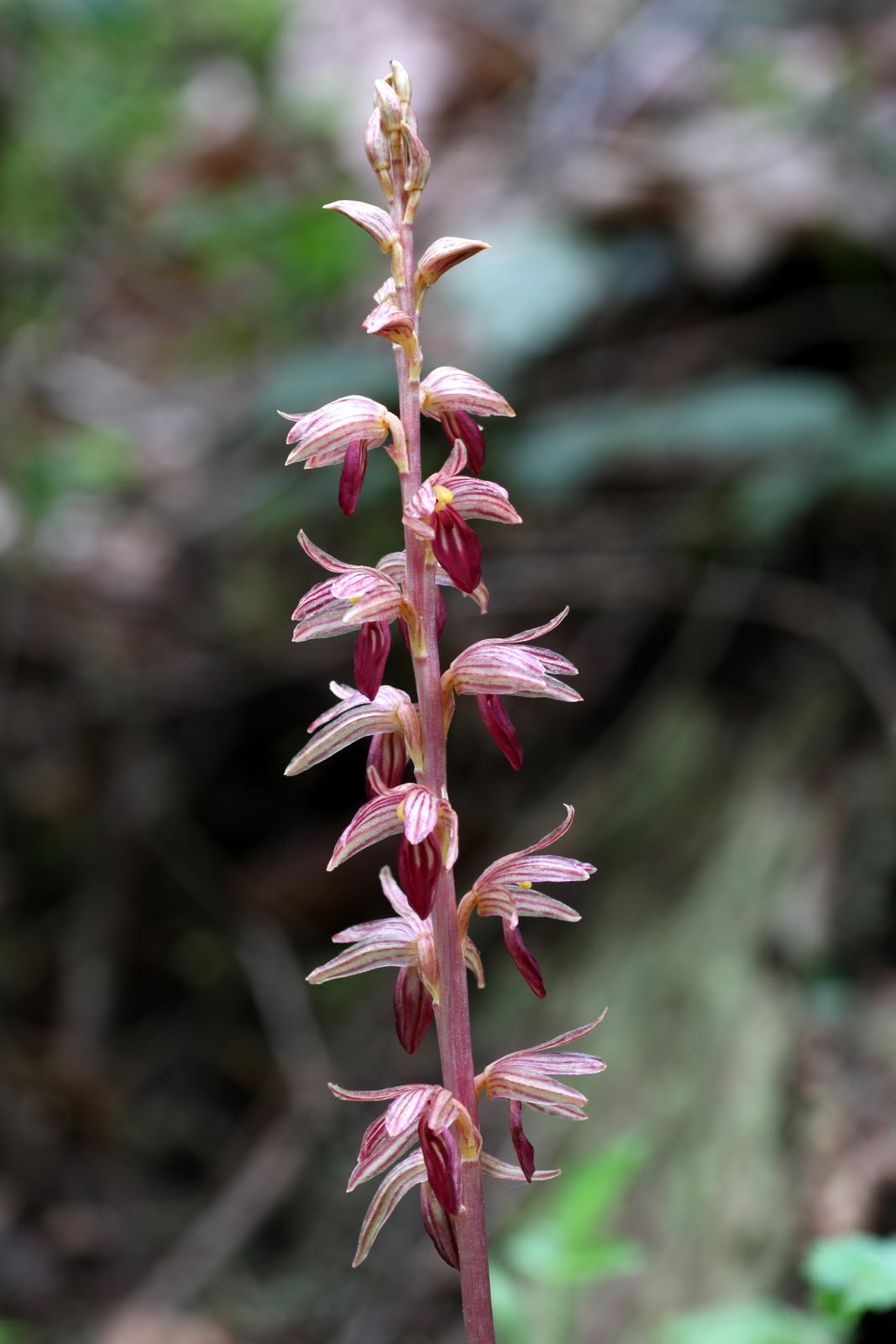
Neottia cordata, the Heart-leaved Twayblade, is a small, hardly noticeable species of our native orchids. We found it hiking in the Columbia Gorge on May 17th, but found it almost accidentally. We had seen Fairy Slippers (Calypso bulbosa) in various locations along the trail and had stopped in one particularly good location to photograph them when we noticed, while crawling around on the ground, that there were Listeras growing in the same location.
Later as we hiked back down the same trail we saw them everywhere, including the red variety, though we had not seen them going up the trail. We are always watching the plants along the trail, so they must be diminutive indeed for us to have missed them. I've described them more fully in another post on this blog: http://nativeorchidsofthepacificnorthwest.blogspot.com/2010/11/heart-leaved-twayblade-listera-cordata.html, so will not describe them in detail again here.
The plants we saw were all less than six inches tall and that along with their location leads me to believe that they were variety nephrophylla, the Western Heart-leaved Twayblade, the reddish form being variety nephrophylla fma. rubescens. They seemed to grow for the most part as individual plants and not clumps, though always in damper, shadier locations. Interestingly, the red form (shown below) was nearly finished flowering, while the green form was at its peak in most cases.
A photographic record of the beautiful and often rare native orchids that can be found in our area.
Wednesday, May 25, 2011
Monday, May 23, 2011
Corallorhiza striata in the Chuckanuts
There is a detailed description of this leafless, saprophytic species already on this blog and the photos there came from the same location as the photos here, but I'm posting this with emphasis on habitat and location: http://nativeorchidsofthepacificnorthwest.blogspot.com/2010/08/striped-coralroot-corallorhiza-striata.html.
As the Coralroots go this is one of the smaller species, but also one of the largest flowered species. The plant is only about a foot tall in this location but the flowers are three quarters of an inch in size and very beautifully colored. This is definitely a species worth looking for and one that will be remembered when found.
There are a number of these growing on the edge of the Interurban Trail in the Chuckanuts, south of Bellingham. The trail is heavily used by bikers, walkers and runners, but the plants are far enough off the path itself that they generally escape damage, though I noticed when I was first there that one spike was broken off.
I counted about a dozen single spikes scattered along the trail, most of them half hidden in the surrounding growth and one larger clump of six spikes in a more open and slightly wetter area. There were more spikes last year, but Coralroots are notorious for their unpredictability and I may also have missed some.
These were found and the location passed on to me by my good friend, Marti Anderson whose blog is well worth following: http://meanderingwa.blogspot.com/2010/05/larrabee-state-park.html. I've been to see them twice this spring, but found only just beginning to open the first time.
Friday, May 6, 2011
Calypso bulbosa in Washington Park
I've posted a fairly detailed description of this species and its varieties previously: http://nativeorchidsofthepacificnorthwest.blogspot.com/2010/07/calypso-bulbosa.html. I'd promised myself, however, that this year I would concentrate on getting pictures not only of the native orchids themselves, but of their habitats and here's the first post by way of keeping that resolve.
Calypso bulbosa, the Fairy Slipper, is the first of our native orchids to bloom, and if one looks in the right places it can be found in abundance. This year I've been to Washington Park on Fidalgo Island, west of the town of Anacortes, Washington, three times to see it, though the first time I went I was a bit early and found only a single flower in bloom.
This is the variety found only west of the of the Rockies and in the North Cascades, C. bulbosa var. occidentalis, the Western Fairy Slipper. It is easily distinguished from the eastern variety, also found here in Washington, by the white rather than yellow beard and by the brown spotting on the lip. These differences can be seen in my previous post.
Some different views of the flowers first. The whitish flower is either not fully open or is well past its prime, probably the latter, since most of those that I saw this color were closing and setting seed. I keep hoping to find the very rare white (alba) form of the species, which has none of the purple or brown color at all, but all I find are these.
As for its habitat, it seems to prefer fairly bright locations under the trees or along the roadsides where there is plenty of moss, good drainage, and relatively flat ground. It generally does not grow in large clumps, but in scattered groups where its requirements are met, seldom more than a few flowers close enough to get them into a picture.
Friday, April 15, 2011
Hooded Ladies'-tresses (Spiranthes romanzoffiana)
This wide ranging species is found across Alaska and Canada, in the northern and western United States and even in Great Britain and Ireland. It is the most commonly-met Spiranthes in the Pacific Northwest. It is somewhat variable in coloration but is unlike any other species in this genus.
The plants are said to grow as tall as 50 cm, but where we have found them, at higher elevations, they have always been very short, less than 20 cm. The plants usually has quite a few leaves which are found on the lower part of the stem and which persist through flowering.
The flowers are a beautiful off-white color and have a sparkling texture, and are arranged in spiralling rows, like all the Spiranthes, around the flower stem. The plant likes wet, open areas. At Mount Adams, for example, we found it growing in a very wet meadow among short grasses.
Western Ladies'-tresses (Spiranthes porrifolia)
This lovely species ranges from Washington south to California and east to Montana and Nevada. It is not uncommon, but is found in only one site in Washington state, where these pictures were taken. It is at the northern limit of its range in Washington.
The name, Ladies' Tresses, the common name of all the Spiranthes refers to the braided appearance of the flower spikes. The individual flowers are arranged in such a way that they spiral around the stem, giving a braided appearance.
This species is 30-40 cm tall in the Washington location, grows in loose clumps, and has three or four leaves at the base of stem. The flowers are creamy white and usually grow in damp areas with good drainage. The individual flowers are only 1 cm in size but each spike holds up to 50 or 60 of the flowers.
Sunday, April 10, 2011
Ute Ladies'-tresses (Spiranthes diluvialis)
This is was the last of all the native orchids of Washington that we saw and photographed. Across its range it is rare and that is the reason it took so long for us to find it. It is thought to be a natural hybrid of Spiranthes romanzoffiana and Spiranthes magnicamporum, the Hooded Ladies'-tresses and the Great Plains Ladies'-tresses. We found it in two of the four locations from which it is known in Washington, about 50 plants in one location and more in the other. It prefers gravel bars, pond edges and riversides. The plant is 30 cm tall and the flowers typical for a Spiranthes species, about 1.5 cm.
Tuesday, March 29, 2011
Slender Bog Orchis (Platanthera stricta)
In the Pacific Northwest this is by far the most common species and the least attractive. Its plain green flowers are only about a cm in size and though abundant, as many as 50 on a spike, would pass unnoticed in most cases, even though the plants are around 100 cm tall.
We have seen this species with stems as thick as a man's finger and as slender as a heavy wire. It is identified by its narrow lip and inflated spur and ranges across the Pacific Northwest as far south as California and as far east as Montana.
Subscribe to:
Posts (Atom)