Thursday, August 20, 2015

Twenty-sixth Orchid of the Season and Others


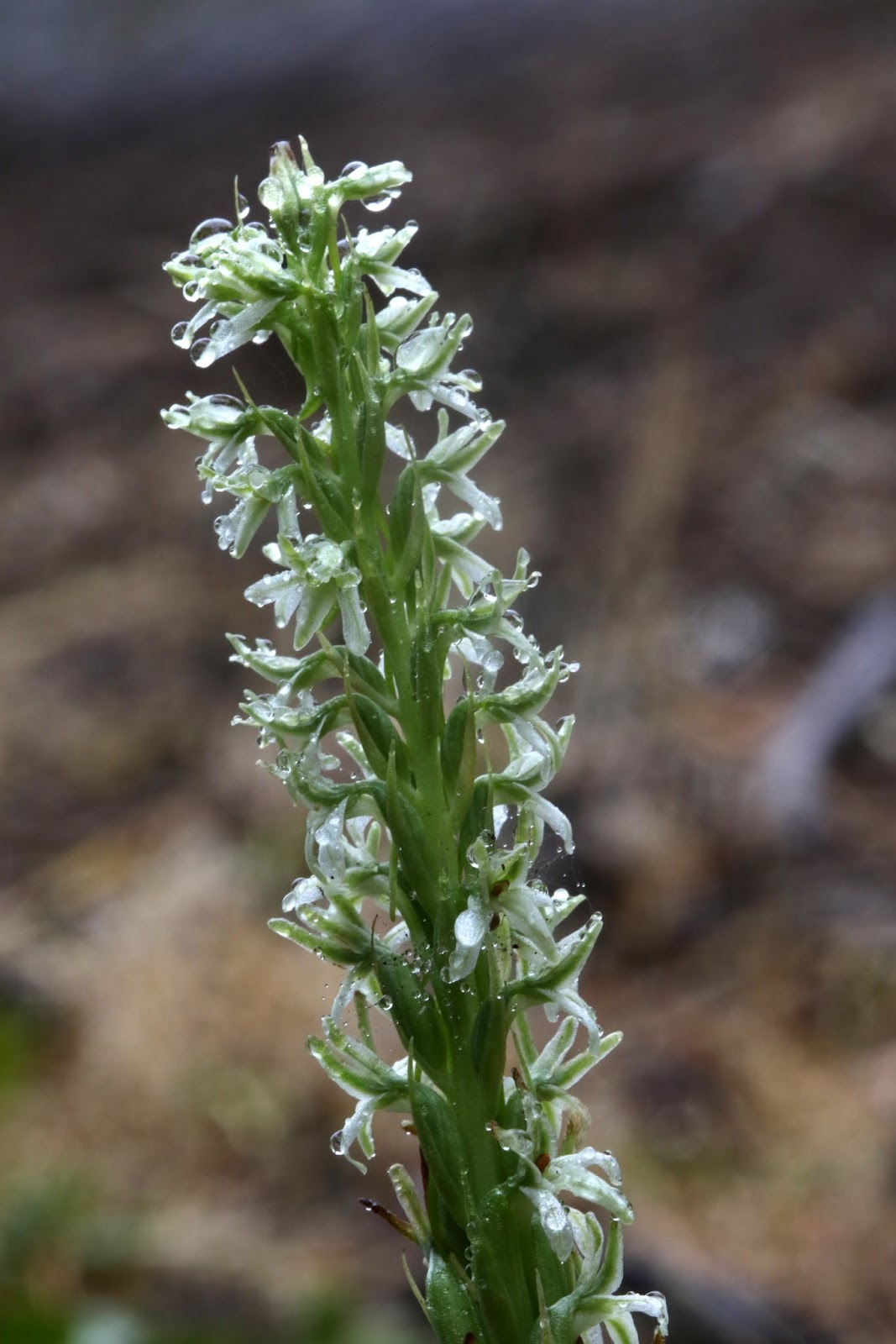
The orchid featured in this post is the Alaskan Piperia, not a common orchid in our area, and in this case a rare dwarf form of the species, Platanthera or Piperia unalascensis fma. olympica.  The species can be as tall as 90 cm but in these are less than 30 cm and are found, as far as I know, only in one location, the top of Hurricane Ridge in Olympic National Park.

Platanthera unalascensis var. olympica


We caught them at the very end of their blooming season, though that was very early this year due our early spring and very hot, dry summer.  Most of them, especially those in exposed areas, were finished, but there were a few in more sheltered areas that were still in good form.  We did not find any sign of the normal form of the species, however, at lower elevations.

Along with this species we saw a number of others in the Olympics which we had seen earlier in the year and elsewhere.  These were seen further west of Hurricane Ridge and included two other Platantheras, the Elegant Piperia, Platanthera elegans, and the Long-spurred Piperia, Platanthera elongata, and the Stream Orchid, Epipactis gigantea, which was almost finished blooming, though very early.

Platantherra elegans


Platanthera elongata


It should be noted that all the Piperias have recently been reclassified as Platantheras, so these species are now Platanthera unalascensis, Platanthera elegans and Platanthera elongata.  These species were all originally classified as Platantheras or Habenarias, but were moved to a new genus in 1901.  There is still a great deal of disagreement about their classification.

Monday, August 17, 2015

Twenty-fifth Orchid of the Season and Others


Neottia banksiana, also known as Listera caurina, is one of our most common orchids.  known as the Northwestern Twayblade, we see it most often in open forests and along trailsides, and that was where we found these examples in Olympic National Park.  At first glance it looks like the much rarer Neottia convallarioides, but is easily distinguished from that species by the blackish markings on the top of the lip.  It grows to 30 cm tall, though these plants were all smaller and carries up to fifteen insect-like flowers.  The friend from Canada who I was with when I photographed these found several plants with a third leaf, a much rarer form of the species, fma. trifolia.

Neottia banksiana


Neottia banksiana fma. trifolia


The same day we found the Neottias we also found Platanthera dilatata var. leucostachys and Platanthera stricta, the Tall White Northern Bog Orchis and the Slender Bog Orchis.  These were growing on wet banks and in wet ditches along the roadside, exactly where one would expect to find them.  Though we found hundreds of the Neottias, these were very few in number, due I am sure to the hot dry summer we've had.  These were still in good conditions but there were far fewer of them than previous years and we found none of the hybrid between the two species, Platanthera xestesii, Estes Rein Orchis, but that may have been due to overly enthusiastic mowing of the roadsides by the Park Service.

Platanthera dilatata var. leucostachys


Realized as I prepared this post that I never photographed Platanthera stricta.

Tuesday, August 11, 2015

Twenty-fourth Orchid of the Season


All the Piperias have been reclassified as Platantheras and so this is probably better known as Platanthera elongata, the Long-spurred Piperia, well named for its long, downward curved spur which is four times the length of the flower.  In any case, it is a lovely species when seen close, but the flowers are very small.  Usually the leaves have withered and disappeared by the time the plant flowers and so all one finds is a spike up to 60 cm tall with 75-100 flowers, though it is often much shorter and with many fewer flowers.  These were just starting to open when I photographed them in the area of Deception Pass on Whidbey Island.  They were growing with plants of Platanthera elegans which were a bit past their prime.


Wednesday, August 5, 2015

Twenty-third Orchid of the Season


This is the smallest of the Platanthera/Piperias that grow in our area, the plants usually 20-45 cm, with many flowers closely packed on the stems.  Piperia transversa, the Flat-spurred Piperia, has been reclassified as a Platanthera transversa, but I have not yet gotten used to the new names.  From a distance the flowers appear to be cream-colored, but close-up they are white and green and are readily distinguished from the other Piperias by the spur which is held at a ninety degree angle to the stem.  The bloom season for this species is slightly later than that of Platanthera elegans and slightly earlier than that of Platanthera elongata, but it is possible to find all three species in bloom at the same time, as I did when these photos were taken in the area of Deception Pass on Whidbey Island.  There were not, however, as many of them this year as previous years, probably on account of the hot dry summer.


Saturday, August 1, 2015

Twenty-second Orchid of the Season


Like the other Piperias this species has been placed back in the genus Platanthera and is now Platanthera elegans.  It grows and blooms in exposed coastal areas and these were photographed near Deception Pass on Whidbey Island.  We've seen plants in the Olympics that were nearly 90 cm tall, but these were all around 30 cm, some even less, though that may be due to a very dry summer.  The flowers, though small, are densely packed and the species is quite showy, the most beautiful of our native Piperias.  Seen close-up the flowers, though they appear to be white, actually have a green stripe down the center of the petals.  The flowers are also faintly fragrant.

 Platanthera elegans


 Platanthera elegans and Platanthera elongata