Tuesday, May 15, 2012

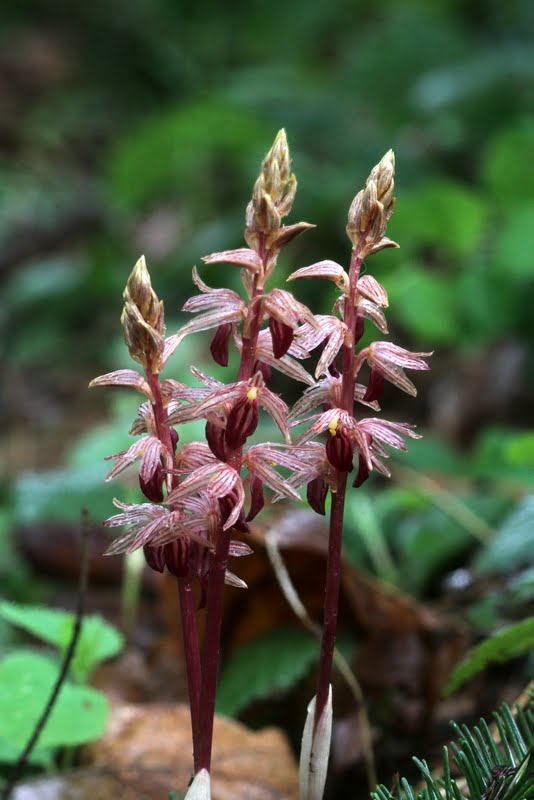
Striped Coralroots in Larrabee State Park


On May 3rd my wife and I went to see if the Striped Coralroots were blooming in Larrabee State Park.  The day was rainy and very wet, but we went anyway and found them in full bloom, more of them than we had seen before.  The rain actually made for some interesting pictures of this most beautiful of our native Coralroots.


The Striped Coralroot (Corallorhiza striata var. striata) has the largest flowers of any of our native Coralroots and is also the most beautiful, though far more difficult to find than the Spotted or Western Coralroot.  We have found it in only two locations though we know of a few others, but the Spotted and Western Coralroots are everywhere.

Monday, April 30, 2012

Western Fairy Slipper (White-flowered Form) in Washington Park


I have been looking for this and hoping to find it for three or four years and finally have seen it, though I can't take credit for finding it.  A friend from Montana was in our area for the tulip festival and visited Washington Park in Anacortes.  She found it and gave us careful directions as to where she had seen it.  It was growing as a single plant in an area where there were quite a few of the normal form.

This is Calypso bulbosa var. occidentalis fma. nivea, the pure white form of the Western Fairy Slipper.  It lacks all the pink-purple color of the normal form and the lip entirely lacks the brown markings, though there is some yellow-green color at the back of the lip.  In the pictures it is evident that it was a wet and rainy day when we went to see it and we came home very wet and muddy, but happy.


Monday, April 23, 2012

Western Fairy Slippers in Washington Park


On Friday, April 20, we took the afternoon and evening off and went to Washington Park near Anacortes, one of our favorite places.  We went to see the Fairy Slippers, expecting that they would be just starting bloom on account of our long cold and wet spring.  We found them at their peak with some of them already starting to go by.  We did not go only to see them, but to see the Oregon Fawn Lilies (Erythronium oregonum), the Few-flowered Shooting Stars (Dodecatheon pulchellum), and other wild flowers which bloom on the cliffs of this beautiful park.  The Fairy Slippers are the main attraction, though, and spring would not be the same without the opportunity to see them.


We saw the other wildflowers in abundance - the Fawn Lilies nearing the end of their brief blooming season, and the Shooting Stars by the thousands at Green Point, but we had come to see the Fairy Slippers and spent most of our time looking for them and photographing them, often lying on the ground or being discovered in some other strange position when others came past.  The Fairy Slippers on this side of the mountains are all the rarer Western variety with a white rather than a yellow beard, Calypso bulbosa var. occidentalis.  We usually found them scattered as single flowers, but in one location found clumps of three to five of them.


Note: for more pictures of the park and its wildflowers, see the following blog posts:
http://ronaldhanko-orchidhunter.blogspot.com/2011/07/washington-park.html
http://ronaldhanko-orchidhunter.blogspot.com/2011/05/washington-park-again.html
http://ronaldhanko-orchidhunter.blogspot.com/2011/04/first-native-orchids-of-year.html
http://ronaldhanko-orchidhunter.blogspot.com/2011/04/washington-park-anacortes.html

Wednesday, December 14, 2011

Goals and Plans for 2012

 Corallorhiza maculata var. ozettensis

Not much hiking this time of the year and certainly no native orchids to look for, but at least we can plan for next summer and spring and have been doing so.  At this point our goals for 2012 are:

1) To see the five native orchids of Washington State that we have not yet seen.  They are Corallorhiza striata var. vreelandii, Cypripedium parviflorum var. makasin, Liparis loeselii, Platanthera sparsiflora and  Spiranthes diluvalis.  We do not expect to see all these in Washington State, since some of them are rare to non-existent in the state.  One site gets mowed every year and another is on private property and the owner will not allow anyone on the property.  If anyone knows of locations for these in the Northwest, please let me know.

2) To get better habitat pictures of many of the orchids we've already seen.  I worked quite hard on this last summer, but still am not satisfied with many of the pictures.  This will involve revisiting many locations, but we are always eager to do that anyway.

As to plans we have the following places on our agenda already in addition to many other locations:

1) The Siskiyous in Oregon.  We've been meaning to go for several years but have not yet made it there.  We want not only to see the orchids of the area but other wildflowers as well, and the scenery including the Oregon coast.  We may even get across the California border if we have sufficient time.

2) Some new orchid sites in the Canadian Rockies.  We've backpacked in Mount Robson Provincial Park two of the last three years and day-hiked there as well, but we now have information on other native orchid sites in Jasper, Banff, Kootenay and elsewhere.  Since we have a daughter, son-in-law and granddaughter in Edmonton, we usually get up that way in the summer.

These are musts, but there are many other locations in Washington, Idaho, Oregon and British Columbia that we have on our list of places to see.

Tuesday, November 1, 2011

Goodyera oblongifolia at Ross Lake


This will be my last post of the year.  The native orchids are all finished blooming now and there is not a lot of time for hiking either.  In a way it's too bad that the last post has to do with an orchid as common and insignificant as this and not with something rarer and more beautiful, but such is life.

The Giant Rattlesnake Orchis is one we see on every hike, at every elevation, and in every possible habitat.  It is around 30 cm tall and has beautifully patterned leaves, but very small whitish tubular flowers.  These were photographed along the Ross Lake trail to Green point where they were growing everywhere in the woods.

Saturday, October 22, 2011

Platanthera elongata at Ross Lake


The last two weeks of August we had our seven year old grandson with us.  He had come with us from Michigan and we took every opportunity to do fun things with him, going whale-watching, visiting the local fair, and going on an overnight backpacking trip.

Knowing that he was not used to hiking, we hiked in only a couple of miles to a favorite spot on Ross Lake in North Cascades National Park called Greenpoint.  There we spent the day after setting up camp and there also we spent the night in our sleeping bags and tents.

The trail we took followed the shore of the lake (created by Ross Dam), gradually climbing above the level of the lake and then dropping back down on a side trail to Greenpoint and the lake.  It was there we found once again a favorite orchid species, the Long-spurred Piperia.


It grew all along the trail though usually only a few scattered spikes in any location.  One of the last orchids to bloom in the area, its leaves had withered and if the 30-40 cm flower spikes had not been there it would have been impossible to locate.

Wednesday, October 12, 2011

Spiranthes romanzoffiana in Yellowstone National Park


We visited Yellowstone National Park for a day on our way to Michigan to see family.  We arrived at the west entrance early in the morning and were informed that road repairs were being done and that there was as much as a five hour delay to get past the road work.  Since it would have taken many hours to drive around to one of the other entrances and even longer to get back to the highway we had left behind we decided to press on.


After driving several miles into the park we found the traffic back up ahead of us as far as we could see and after waiting for a while we found that every half-hour or so the traffic would move about a mile ahead.  Every time we stopped after moving we got out of the car and explored the area, a very nice area of the park that follows the peaceful Madison River.  We both had our cameras and thus passed the time.


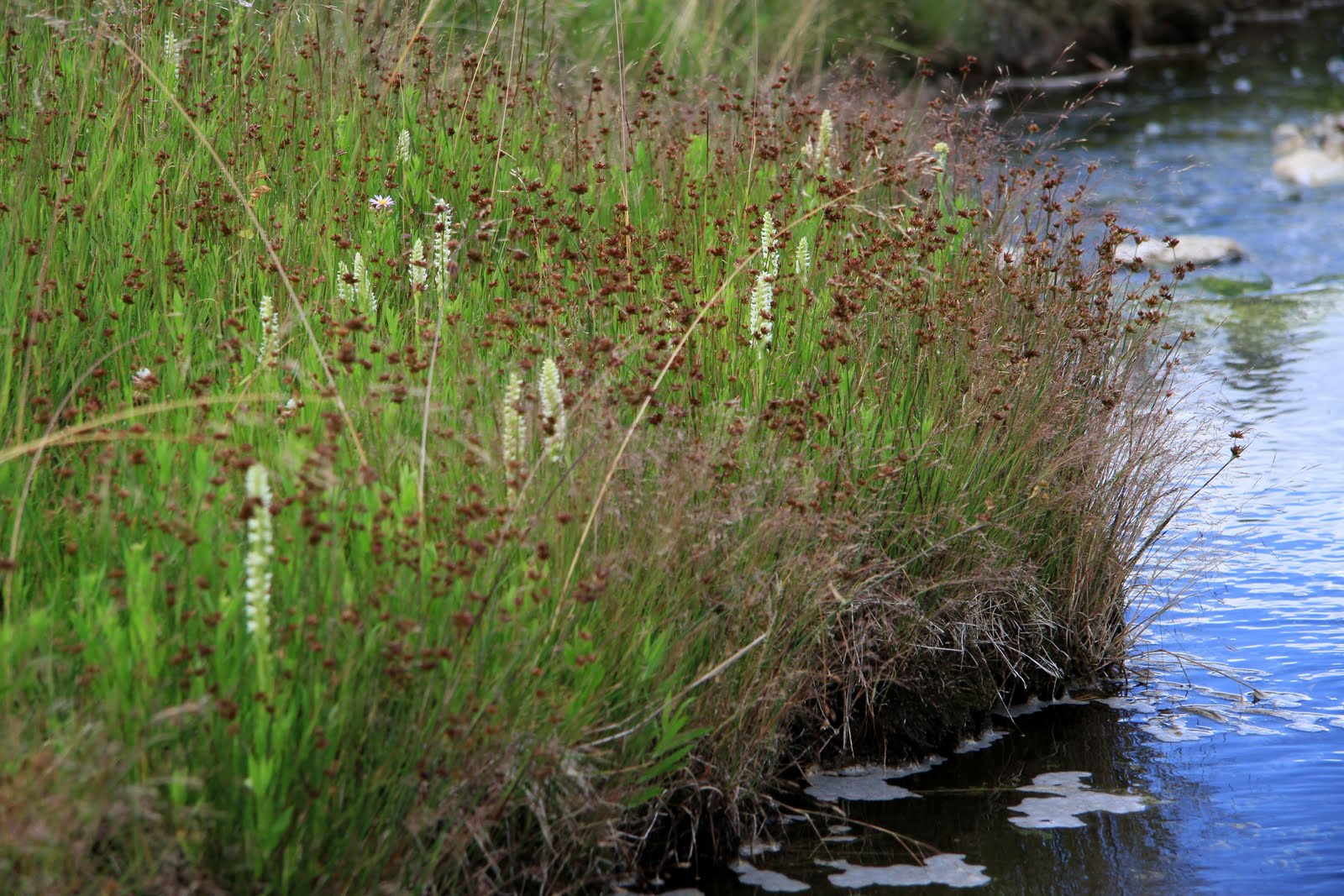
At one stop we found this native orchid growing the grass along the river's edge and were quite excited to find it so far away from any location we had previously discovered.  Later in the day, however, after getting free of the traffic and driving up the west side of the north loop we found the orchid several more times, in some of the geyser basins growing right in the area of the geyser run-off and later along the Gibbon River.


The orchid is one we've seen several times in Washington and that is my justification for posting it here.  It is a small plant, usually less than 30 cm tall with cream colored flowers that are braided around the flower spike, giving the genus its common name, Ladies' Tresses.  This particular species is the Hooded Ladies' Tresses, and is quite common in our area and further east, but always very beautiful.

As always we found the orchid growing in wetter areas, near streams, in run-off areas of the geysers, in wet, almost boggy meadows.  And, once we knew that it was blooming in the park, we were able to spot it in wetter areas as we drove through the park.The photo of the plants growing near a stream was taken in an area we spotted from the car window.