A photographic record of the beautiful and often rare native orchids that can be found in our area.
Thursday, September 4, 2014
Galearis rotundifolia fma. wardii
The Small Round-leaf Orchis, Galearis rotundifolia, has a number of color forms. We always look for these when we find this species, though some of the forms are quite rare and hard to find. Hiking the Berg Lake trail in the Canadian Rockies this summer, the species was finished at lower elevations but we found it in abundance higher up and among the many plants we saw we found a couple of plants that had white flowers instead of the usual pink, but that were not completely white, the lip showing faint pink markings along with a green spots at the base of the lip. This is a named form, Galearis rotundifolia fma. wardii.
Friday, August 29, 2014
Platanthera obtusata ssp. obtusata
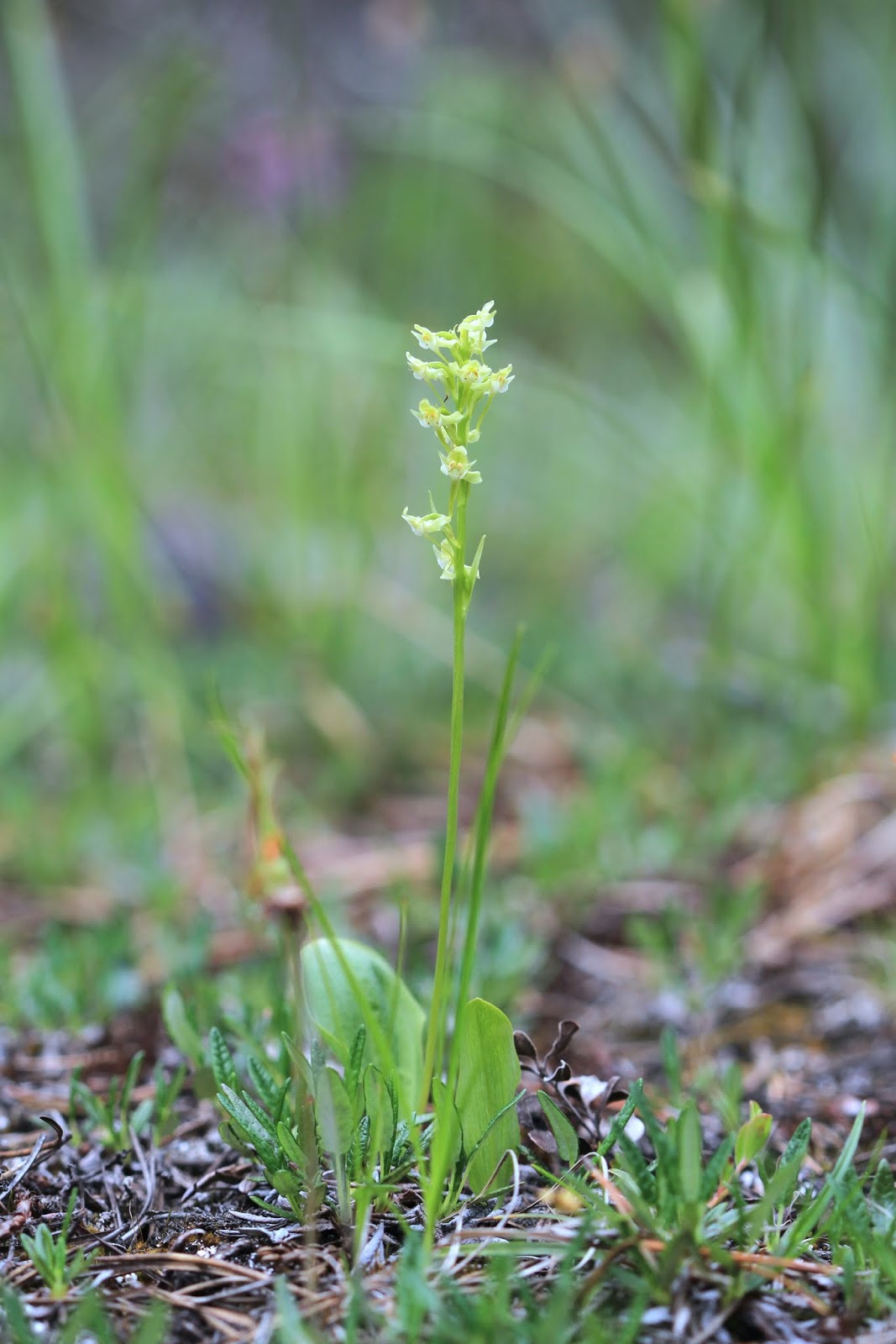
Platanthera obtusata, ssp. obtusata, the Blunt-leafed Rein Orchis is found only in the far northeast corner of Washington but is very common further north and east. It grows "in the mountains east of the coastal ranges south of Alaska." The single "blunt" leaf is distinctive and with its flower spike the plant is only 35 cm tall. The whitish-green flowers are 2 cm and resemble a long-tailed bird in flight. It is not a striking species but has a quiet beauty all its own.
July 8
(Canadian Rockies)
July 10
(Canadian Rockies)
Wednesday, August 27, 2014
Galearis rotundifolia
This species was once classified as Amerorchis. It is closely related to the European genus Orchis and was once classified as part of that genus. Under either name, it is the only such species in the North America. It does not, however, grow in Washington, though it grows in Idaho and Montana and other northern states further east. It is not a large plant, growing to 20 cm tall with 1.5 cm flowers. Where it is found, however, it often grows in profusion, carpeting the ground. We have been in places where it grows so thickly it is difficult to walk without stepping on plants. It has a number of different color forms one of which we found this summer and which will be the subject of a future post.
July 8
(Canadian Rockies)
July 10
(Canadian Rockies)
Subscribe to:
Posts (Atom)