A photographic record of the beautiful and often rare native orchids that can be found in our area.
Showing posts with label saprophyte. Show all posts
Monday, May 23, 2011
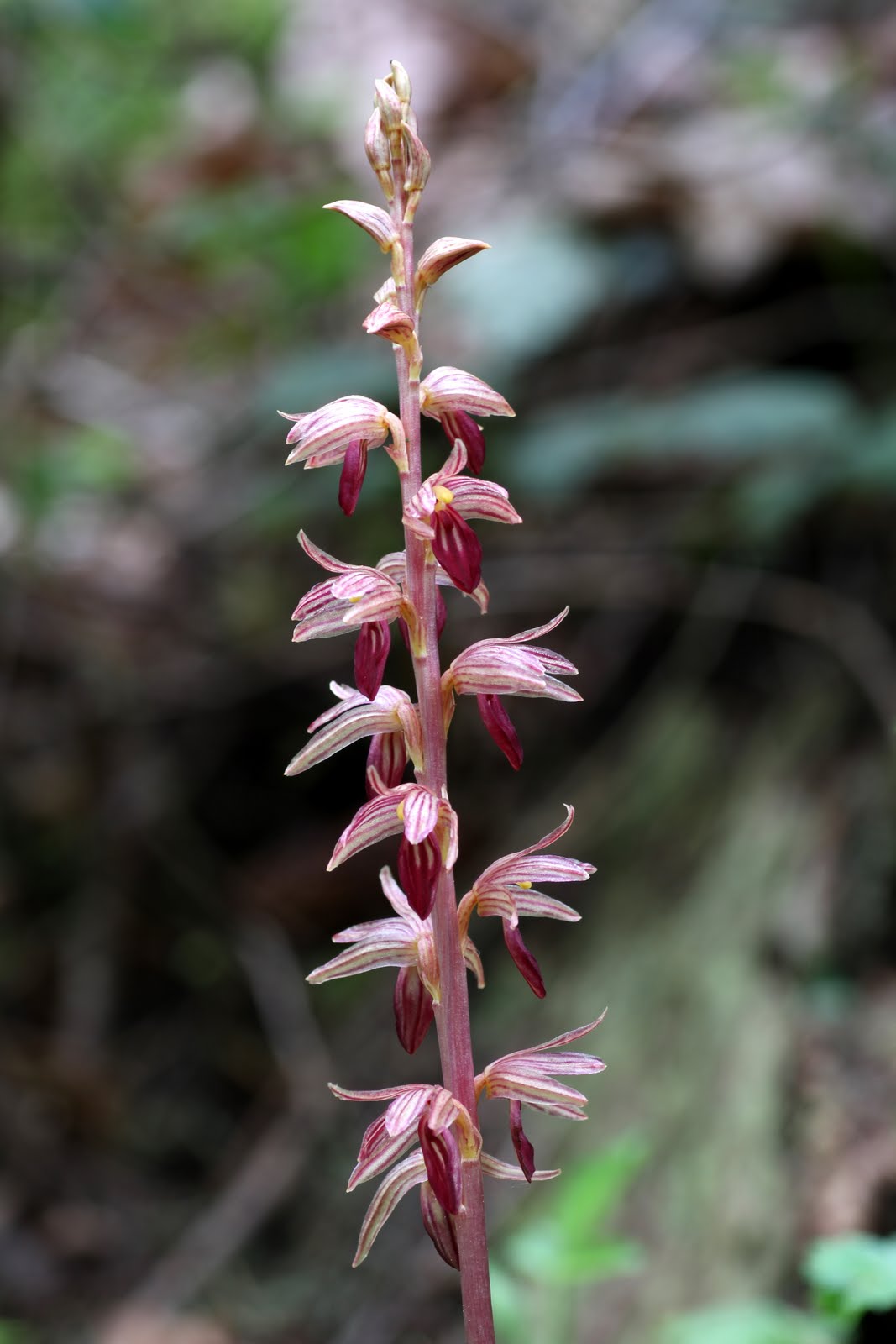
Corallorhiza striata in the Chuckanuts
There is a detailed description of this leafless, saprophytic species already on this blog and the photos there came from the same location as the photos here, but I'm posting this with emphasis on habitat and location: http://nativeorchidsofthepacificnorthwest.blogspot.com/2010/08/striped-coralroot-corallorhiza-striata.html.
As the Coralroots go this is one of the smaller species, but also one of the largest flowered species. The plant is only about a foot tall in this location but the flowers are three quarters of an inch in size and very beautifully colored. This is definitely a species worth looking for and one that will be remembered when found.
There are a number of these growing on the edge of the Interurban Trail in the Chuckanuts, south of Bellingham. The trail is heavily used by bikers, walkers and runners, but the plants are far enough off the path itself that they generally escape damage, though I noticed when I was first there that one spike was broken off.
I counted about a dozen single spikes scattered along the trail, most of them half hidden in the surrounding growth and one larger clump of six spikes in a more open and slightly wetter area. There were more spikes last year, but Coralroots are notorious for their unpredictability and I may also have missed some.
These were found and the location passed on to me by my good friend, Marti Anderson whose blog is well worth following: http://meanderingwa.blogspot.com/2010/05/larrabee-state-park.html. I've been to see them twice this spring, but found only just beginning to open the first time.
Monday, August 9, 2010
Early Coralroot (Corallorhiza trifida)
The Early Coralroot is the most widespread of all the Coralroots. It is also the most insignificant in appearance. It is found not only from Alaska east across Canada and in the northern and western United States, but is very common in Europe and Asia. It is usually smaller than the other Coralroots (to 25 cm in height), fewer flowered (5-10 flowers on the plants we have seen),and in color a very plain green and white.
The flowers themselves are slightly less than 1 cm in size, and though they can be spotted purple, they are so small that one has to look closely to see the purple spotting. Like the other Coralroots, they grow in rather shady forests, though in our experience in slightly damper locations than the others. As the name suggests, they bloom early, often with the Trilliums and other early wildflowers, but later at high elevations.
Thursday, August 5, 2010
Striped Coralroot (Corallorhiza striata var. striata)
The showier variety, shown here, is found across Canada from British Columbia to Newfoundland and as far south in the United States as California, Texas and New York. The flowers are about 1.5 cm in size, the plants about 30 cm tall and they can have as many as 30 flowers per spike.
Like all the other Coralroots, this species is leafless and saprophytic, living off decaying matter in the soil and obtaining nourishment through a fungus. There are several color forms, both a tan form and a yellowish form, but these are also quite rare.
Note (nearly two years later): we finally had opportunity to see variety vreelandii at two locations in the Columbia River Gorge, at Drano Lake and Dog Mountain though we only found a few at each location.
Tuesday, August 3, 2010
Ozette Coralroot (Corallorhiza maculata var. ozettensis)
The Ozette Coralroot is considered to be a variety of the Spotted Coralroot, the species posted in the previous entry. It is so different from the Spotted Coralroot, however, and so rare, that I'm posting this description separately.
This rare orchid was discovered in 1967 and first described in 2001 by Mr. Ed Tisch of Port Angeles, Washington. It was found in one location in Clallam County on the Olympic Peninsula in the coastal forests of that county. It was thought, at the time of its discovery, to be confined to that one county, but has since been discovered in several locations across the water on Whidbey Island. It was discovered there in 2006 by a young lady named Chelsea Kieffer while studying at the Pacific Rim campus of the Au Sable Institute on that island. She found it in the woods on the property of the Institute. That is where we've seen it.
This plant is from eight inches to two feet tall and has bright reddish-purple stems. The plants we've seen had from six to twenty-six flowers that completely lacked the spotting of the other two varieties, the Western Coralroot and the Western Spotted Coralroot. The flowers were the same color as the stem on the exterior, but opened a greenish color on the inside with green petals
lightly striped in red-purple, a white lip, and a yellow column.
As with all the other Coralroots, this plant is leafless, sending up its flowering stems in June and July, and leaving no trace of itself except dead spikes when finished. It is thought to be saprophytic, getting its nourishment not through photosynthesis, but from the roots of other plants and by means of a soil fungus. Its root looks like a piece of coral, hence its name. This unique plant was named after the Ozette Indians who were the original occupants of the land on which it was first found. I am not a taxonomist and have to trust the judgment of those who know better than I, but this plant looks so different from the other Western Coralroots, that it is hard to believe they are not entirely different species. It is considered “of special concern” by the USDA.
Interesting facts:
(1) All the colonies discovered in Clallam County on the Olympic Peninsula were found at about 300 meters from the ocean.
(2) In his book, Paul Martin Brown says that this variety is always found in pure colonies, but the plants on Whidbey Island were not in such colonies. They were growing among and with other plants of the Western Spotted Coralroot.
Note: much of this article has been published by the American Orchid Society on its web page at: Ozette Coralroot.
This rare orchid was discovered in 1967 and first described in 2001 by Mr. Ed Tisch of Port Angeles, Washington. It was found in one location in Clallam County on the Olympic Peninsula in the coastal forests of that county. It was thought, at the time of its discovery, to be confined to that one county, but has since been discovered in several locations across the water on Whidbey Island. It was discovered there in 2006 by a young lady named Chelsea Kieffer while studying at the Pacific Rim campus of the Au Sable Institute on that island. She found it in the woods on the property of the Institute. That is where we've seen it.
This plant is from eight inches to two feet tall and has bright reddish-purple stems. The plants we've seen had from six to twenty-six flowers that completely lacked the spotting of the other two varieties, the Western Coralroot and the Western Spotted Coralroot. The flowers were the same color as the stem on the exterior, but opened a greenish color on the inside with green petals
lightly striped in red-purple, a white lip, and a yellow column.
As with all the other Coralroots, this plant is leafless, sending up its flowering stems in June and July, and leaving no trace of itself except dead spikes when finished. It is thought to be saprophytic, getting its nourishment not through photosynthesis, but from the roots of other plants and by means of a soil fungus. Its root looks like a piece of coral, hence its name. This unique plant was named after the Ozette Indians who were the original occupants of the land on which it was first found. I am not a taxonomist and have to trust the judgment of those who know better than I, but this plant looks so different from the other Western Coralroots, that it is hard to believe they are not entirely different species. It is considered “of special concern” by the USDA.
Interesting facts:
(1) All the colonies discovered in Clallam County on the Olympic Peninsula were found at about 300 meters from the ocean.
(2) In his book, Paul Martin Brown says that this variety is always found in pure colonies, but the plants on Whidbey Island were not in such colonies. They were growing among and with other plants of the Western Spotted Coralroot.
Note: much of this article has been published by the American Orchid Society on its web page at: Ozette Coralroot.
Monday, August 2, 2010
Spotted Coralroot (Corallorhiza maculata)
There are seven species and varieties of Coralroots that grow in our area and one that was thought to be indigenous (unique) to Western Washington, the Ozette Coralroot, but has proved to be more widespread, though still rare. Two of the others are quite rare.
Coralroots are named for their large coral-like rhizomes, undergrounds "stems" that produce both roots and shoots. The Coralroots all live off fungi in the soil (they are mycotrophic), produce little or no chlorophyll, and are leafless.
The Spotted Coralroot is the most common of all the species in North America, though one other species, the Early Coralroot, is found also in Europe and is very common there. In its two varieties, the Spotted Coralroot is found in Alaska, across Canada from British Columbia to Newfoundland, and across most of the United States with exception of Kansas, Oklahoma, Missouri, Arkansas, Louisiana, Alabama, Mississippi, and Florida.
There are two very similar varieties of this orchid distinguished only by the shape of the lip and the flowering time, though they often grow together in the same areas. Both varieties have at least several different color forms, some of which are quite rare. These two varieties both varieties grow to about 50 cm tall and both have numerous flowers, as many as thirty on a spike. The flowers, however, are quite small, 5-8 millimeters each.
The later flowering and more common variety is Corallorhiza maculata var. maculata. It is easily distinguished by the side lobes of the lip which are parallel and by the shape of the flowers which are more cupped than the other variety. The stem color and flower color vary from tan to red in both varieties, though with var. maculata the color red is more common in our experience.
The other variety, Corallorhiza maculata var. occidentalis, the Western Spotted Coralroot, is really misnamed, since it ranges as far as eastern Canada and the eastern United States and as far south as Virginia. It is distinguished by a lip with a wider, almost circular, mid-lobe and more open flowers than the first and more common variety.
There is also a third variety of Corallorhiza maculata, variety ozettensis, but this variety is so unusual and so rare that I'll post it as a separate article.
Coralroots are named for their large coral-like rhizomes, undergrounds "stems" that produce both roots and shoots. The Coralroots all live off fungi in the soil (they are mycotrophic), produce little or no chlorophyll, and are leafless.
The Spotted Coralroot is the most common of all the species in North America, though one other species, the Early Coralroot, is found also in Europe and is very common there. In its two varieties, the Spotted Coralroot is found in Alaska, across Canada from British Columbia to Newfoundland, and across most of the United States with exception of Kansas, Oklahoma, Missouri, Arkansas, Louisiana, Alabama, Mississippi, and Florida.
There are two very similar varieties of this orchid distinguished only by the shape of the lip and the flowering time, though they often grow together in the same areas. Both varieties have at least several different color forms, some of which are quite rare. These two varieties both varieties grow to about 50 cm tall and both have numerous flowers, as many as thirty on a spike. The flowers, however, are quite small, 5-8 millimeters each.
The later flowering and more common variety is Corallorhiza maculata var. maculata. It is easily distinguished by the side lobes of the lip which are parallel and by the shape of the flowers which are more cupped than the other variety. The stem color and flower color vary from tan to red in both varieties, though with var. maculata the color red is more common in our experience.
The other variety, Corallorhiza maculata var. occidentalis, the Western Spotted Coralroot, is really misnamed, since it ranges as far as eastern Canada and the eastern United States and as far south as Virginia. It is distinguished by a lip with a wider, almost circular, mid-lobe and more open flowers than the first and more common variety.
There is also a third variety of Corallorhiza maculata, variety ozettensis, but this variety is so unusual and so rare that I'll post it as a separate article.
Wednesday, July 28, 2010
Phantom Orchid (Cephalanthera austiniae)
The Phantom Orchid is certainly the most unusual of our native orchids. It is the only North American species from the genus Cephalanthera, but even among the other species of that genus it is unique. It is saprophytic, living off decaying material in the soil, and completely without chlorophyll.
Stem, leaves and flowers are bone white, with only a spot of yellow on the lips of the flowers. The leaves are very small and the plant is mostly stem and flowers, growing as tall as 60 cm with flowers that are quite large, about 3 cm. All this adds up to quite show when the plants are in flower.
They grow on the forest floor, often in very open, but heavily shaded and dark areas, and the white plants make a dramatic show that cannot be missed, and that has earned this species its common name. Typical was a location we visited recently and at which the following photos were taken.
We were on the Washington side of the Columbia River Valley and had followed an old Forest Service road into a dry, mature woodland where there was almost no underbrush. Almost as soon as we entered the shady woods we could see the Phantom Orchids growing on the hillside above us mostly as individual plants scattered over a large area.
Two species of Coralroots were growing in the same area, though both were finished flowering. This was no surprise since they too are saprophytes and prefer similar conditions. The Phantom Orchids, however, were much more visible than the Coralroots.
Stem, leaves and flowers are bone white, with only a spot of yellow on the lips of the flowers. The leaves are very small and the plant is mostly stem and flowers, growing as tall as 60 cm with flowers that are quite large, about 3 cm. All this adds up to quite show when the plants are in flower.
They grow on the forest floor, often in very open, but heavily shaded and dark areas, and the white plants make a dramatic show that cannot be missed, and that has earned this species its common name. Typical was a location we visited recently and at which the following photos were taken.
We were on the Washington side of the Columbia River Valley and had followed an old Forest Service road into a dry, mature woodland where there was almost no underbrush. Almost as soon as we entered the shady woods we could see the Phantom Orchids growing on the hillside above us mostly as individual plants scattered over a large area.
Two species of Coralroots were growing in the same area, though both were finished flowering. This was no surprise since they too are saprophytes and prefer similar conditions. The Phantom Orchids, however, were much more visible than the Coralroots.
Subscribe to:
Posts (Atom)


%20%233.jpg)