Showing posts with label western ladies' tresses. Show all posts

Wednesday, July 30, 2014

Spiranthes porrifolia


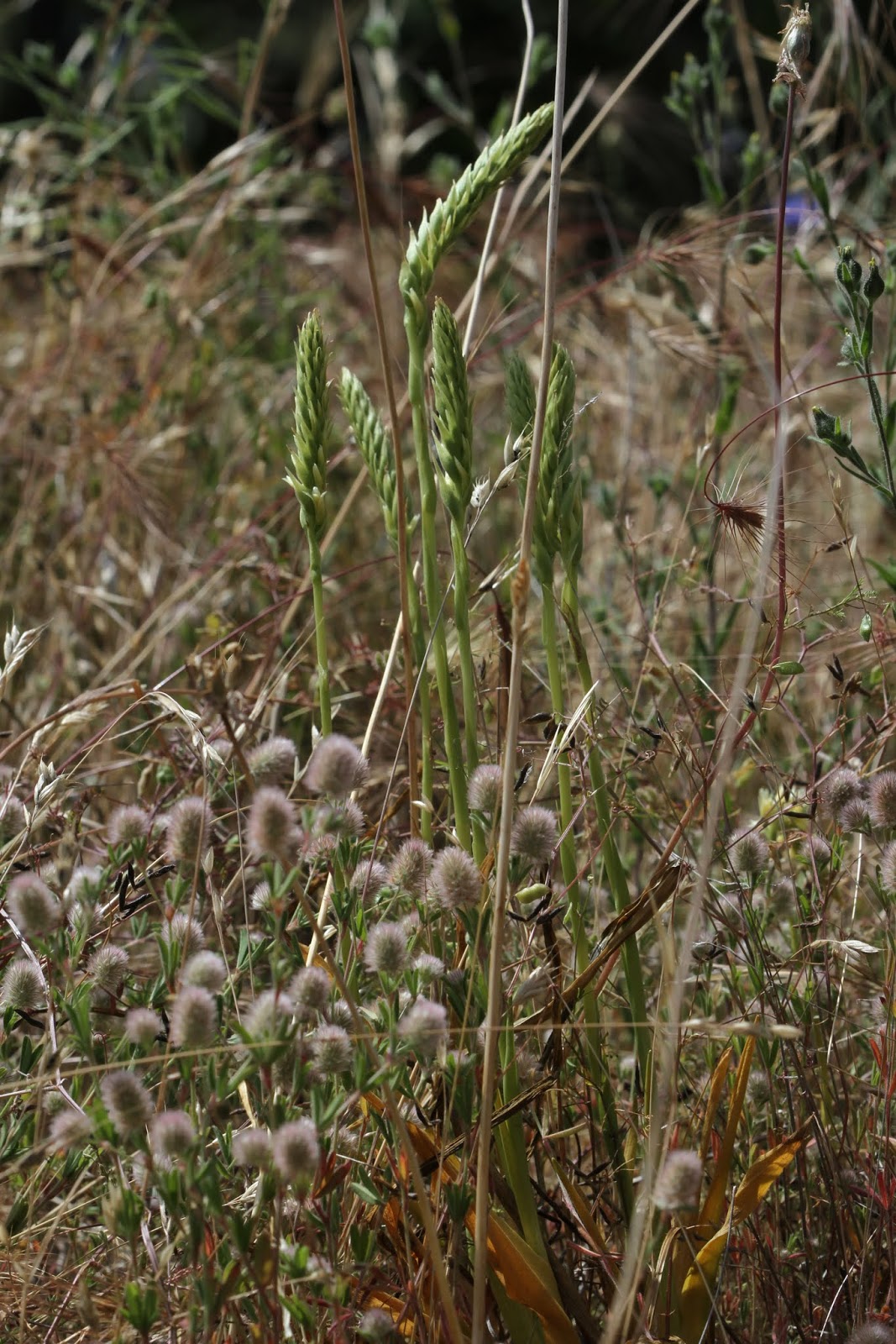
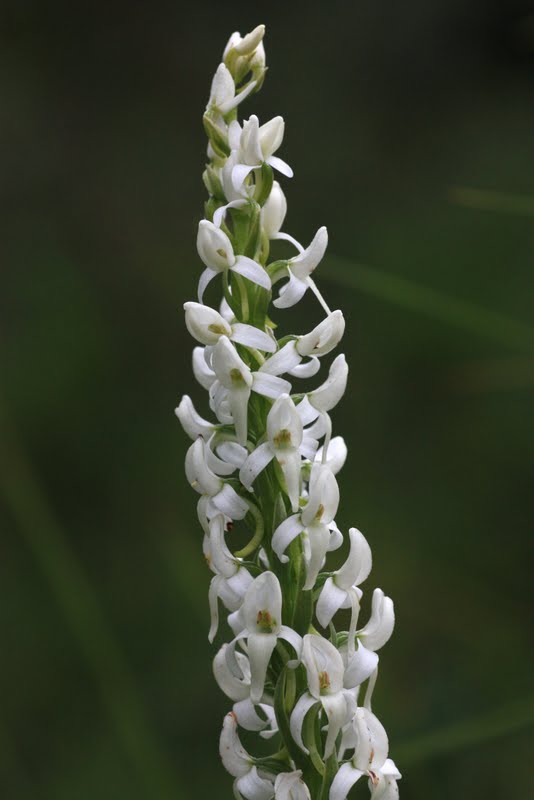
Spiranthes porrifolia, the Western Ladies'-tresses, is one of three Spiranthes in Washington.  It is more abundant in Oregon and California, but is known from only one location in Washington.  We visited that location this summer with friends from Germany and found it growing where expected, but only a very few plants where in previous years we had found as many as sixty or seventy plants.  The location was very hot and dry this summer, more so than usual and earlier than usual and that may account for the lack of plants.  This species is taller than our more common Hooded Ladies-tresses, Spiranthes romanzoffiana, and has flowers that are more tubular and more cream-colored than that species.

June 23


Wednesday, September 12, 2012

Candles and Ladies' Tresses at Lake Elizabeth


Lake Elizabeth is a small alpine lake on the east side of the North Cascades near Skykomish, Washington.  It can be reached by a Forest Service road, but until this year, some large sections of the road were washed out and visiting the lake required a 14 mile hike.  In spite of that we had visited the lake several times, including one visit with the Washington Native Orchid Society.  This year, however, the road was finally repaired and we were able to drive to the lake, with the result that we visited it three times, a side trip on the way to eastern Washington.

On the trip described here we were looking for a tiny and inconspicuous, but rare native orchid known as Chamisso's Orchid (Platanthera chorisiana) which grows in the sedge mat on the far side of the lake.  We had attempted on other occasions to find this rarity, but unsuccessfully.  This time we found it, but it was nearly finished blooming with the leaves already yellowing and I did not bother to take pictures.  We will have to go again next summer and catch it in bloom.  The picture below, therefore, was taken on another trip to Vancouver Island.


We did find a couple of other orchids blooming on this visit, two varieties of Platanthera dilatata, the Sierra Rein Orchid, and the Tall White Northern Bog Orchis, along with the Hooded Ladies' Tresses, Spiranthes romanzoffiana.  All were blooming in abundance in the same area as Chamisso's Orchid, though the Spiranthes, we were told by a friend, had not been very abundant the previous year.  Unlike the tiny Platanthera, which has very tiny green flowers, these have white flowers and are easy to find.


The Sierra Rein Orchid and the Tall White Northern Bog Orchis, Platanthera dilatata var. leucostachys, and var. dilatata, are two of three varieties of Platanthera dilatata, all three of them often referred to as Bog Candles.  These three varieties are distinguished by the length of the spur, in var. dilatata about the length of the lip and in var. leucostachys clearly longer than the lip.  We have not found the long-spurred variety as often as the others and were delighted to find it in this location.  All three varieties are sweetly scented.

variety dilatata


variety leucostachys


The Hooded Ladies' Tresses is quite common in our area and we've found it in a number of new locations this summer.  Its braided appearance, with the small cream-colored flowers usually spiraling around the flower spike is also a welcome find in spite of its broad range and the fact that it is so common.  In most cases here we found it growing as single plants but there were also a couple of nice clumps growing on small hump of land near some draining water.  Like the Bog Orchid it prefers wetter areas.


In addition I found a small plant that I am not even sure is an orchid, since the flowers were not yet open.  If it is an orchid, the only thing it can be is Coeloglossum viride, the Bracted Green Orchis, but I am puzzled by the tiny size of the plant, the few flowers and the location in which I found it.

Coeloglossum viride has two varieties, var. virescens, the Long-bracted Green Orchis, or Long-bracted Frog Orchid, and which is rare in Washington and only reported from one county.  It is rather robust plant, up to 80 cm tall, with numerous flowers and fairly thin leaves.

This plant was tiny, 8 cm tall, with only a few flowers and appears to me to be var. viride, Northern Bracted Green Orchis, or Northern Frog Orchid.  The difficulty with this identification is that the smaller variety has never been reported from Washington State, and is confined to Alaska and the far north.


Tuesday, July 24, 2012

Stream Orchids and Western Ladies' Tresses along the Rogue River


Only July 11 we spent most of the day exploring the Knopki Creek Road in the California Siskiyous, leaving little time for other sites we had hoped to explore.  We did however manage to visit one other easily accesible site along the Rouge River in Oregon, where we had been told we could find the Stream Orchid, Epipactis gigantea, growing.

We were used to finding this orchid growing so close to water that it was almost impossible to photograph without getting wet, but in this case the plants, quickly found, were well back from the edge of the river, growing among the rocks and in the sand just at the edge of the vegetation on the riverbank and fairly well shaded by the other plants.


This plant is supposed to grow as tall as 100 cm, though we have never seen it that large.  Here the plants we found were less than 30 cm tall.  The leaves are pleated and the flowers are around 3 cm in size, very beautiful and very showy.  There can be up to twenty-five flowers per spike, though here there were on five or six per spike.


Just before we finished I noticed a small bee that had been hanging around the flowers was now perched on the anther cap of one of the flwoers and as I watched began to scratch at the cap and eventually pulled itfar enough up that he was able to crawl underneath.  He spent quite a bit of time digging around there and appeared to have some pollen attached to him.


We had been told about the Epipactis, but to our delight we found quite a number of spikes of Western Ladies' Tresses, Spiranthes porrifolia, growing with and among the Epipactis.  This orchid, though not uncommon elsewhere is found in only one place in Washington State and is not at all common in Oregon and even where common is lovely indeed.


This species is usually 30-40 cm tall  but here was only 15-20 cm.  The flowers are tubular, creamy white and usually grow in damp areas with good drainage.  The individual flowers are only 1 cm in size but each spike holds up to 50 or 60 of the flowers.  Like all the Spiranthes, the flower spikes appear to be "braided," giving rise to the name "Ladies' Tresses."

Wednesday, October 12, 2011

Spiranthes romanzoffiana in Yellowstone National Park


We visited Yellowstone National Park for a day on our way to Michigan to see family.  We arrived at the west entrance early in the morning and were informed that road repairs were being done and that there was as much as a five hour delay to get past the road work.  Since it would have taken many hours to drive around to one of the other entrances and even longer to get back to the highway we had left behind we decided to press on.


After driving several miles into the park we found the traffic back up ahead of us as far as we could see and after waiting for a while we found that every half-hour or so the traffic would move about a mile ahead.  Every time we stopped after moving we got out of the car and explored the area, a very nice area of the park that follows the peaceful Madison River.  We both had our cameras and thus passed the time.


At one stop we found this native orchid growing the grass along the river's edge and were quite excited to find it so far away from any location we had previously discovered.  Later in the day, however, after getting free of the traffic and driving up the west side of the north loop we found the orchid several more times, in some of the geyser basins growing right in the area of the geyser run-off and later along the Gibbon River.


The orchid is one we've seen several times in Washington and that is my justification for posting it here.  It is a small plant, usually less than 30 cm tall with cream colored flowers that are braided around the flower spike, giving the genus its common name, Ladies' Tresses.  This particular species is the Hooded Ladies' Tresses, and is quite common in our area and further east, but always very beautiful.

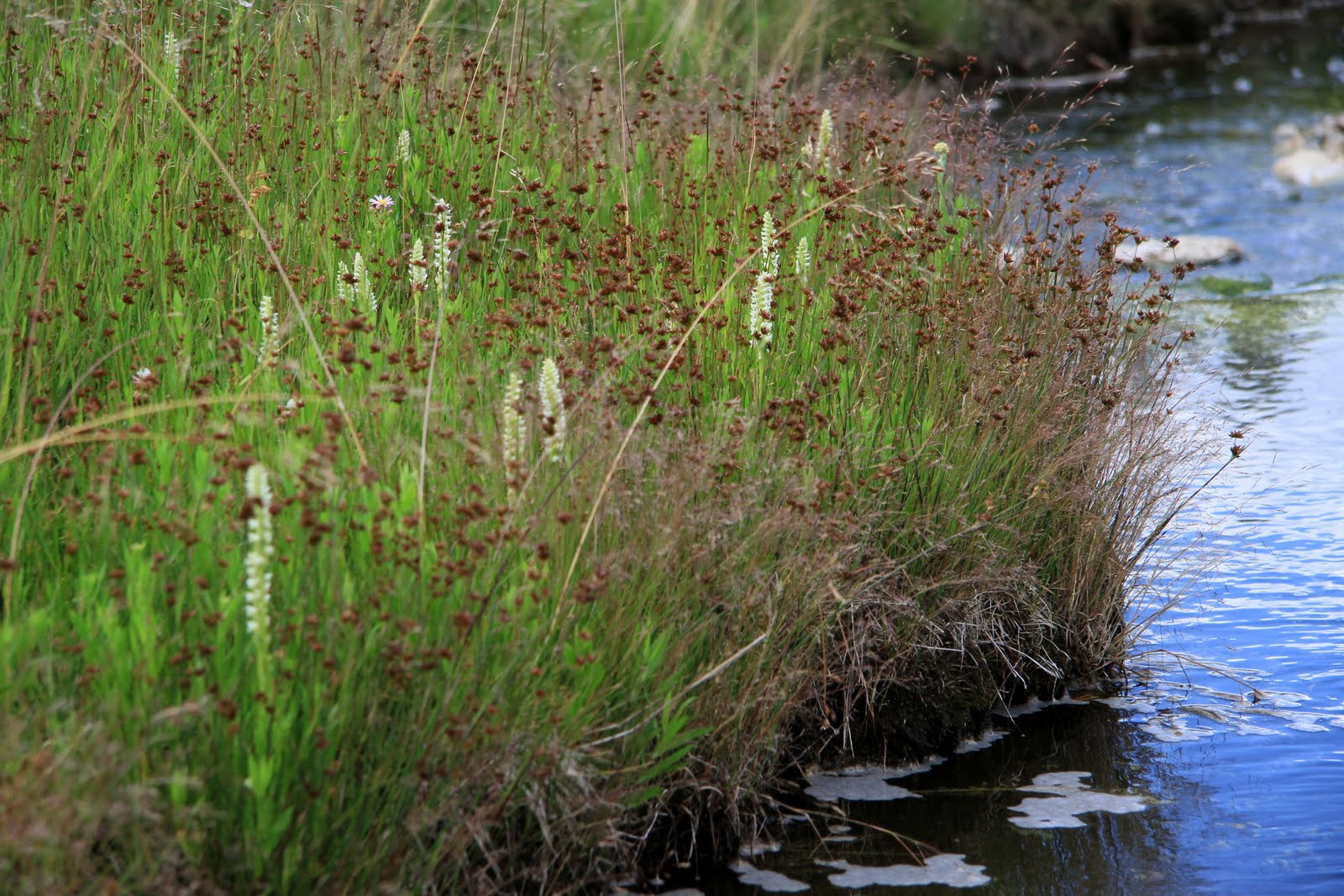
As always we found the orchid growing in wetter areas, near streams, in run-off areas of the geysers, in wet, almost boggy meadows.  And, once we knew that it was blooming in the park, we were able to spot it in wetter areas as we drove through the park.The photo of the plants growing near a stream was taken in an area we spotted from the car window.