Showing posts with label dactylorhiza. Show all posts

Thursday, December 11, 2014

Some Name Changes


There have been a number of name changes recently among our native orchids, mostly changes of genus, that have shuffled many of the orchids back into older genera.  Most of this taxonomic revision appears to have been done by Richard Bateman.  Whether these names will stick remains to be seen, but at least for now these appear to be the current names.

First, Coeloglossum viride var. viridis, the Frog Orchis or Long-bracted Green Orchis, is now once again Dactylorhiza viridis var. virescens.


Second, all the Listeras have been moved back to the genus Neottia.  This involves a total of four species from the Pacific Northwest.

Neottia borealis


Neottia cordata


Neottia banksiana


Neottia convallarioides


Third, all the Piperias, five species, have been moved back into the genus Platanthera, with Piperia candida changed to Platanthera ephemerantha.

Platanthera unalascensis


Platanthera elegans


Platanthera transversa and Platanthera elongata


Platanthera ephemerantha


Fourth, Malaxis monophyllos var. brachypoda seems now to be the accepted name for Malaxis brachypoda in spite of differences between that species and its Eurasian counterpart.


Fifth, the Small Round-leaf Orchis, Amerorchis rotundifolia, is now Galearis rotundifolia, a completely new genus for this species.


It is sometimes hard to keep up with the changes and to remember them, especially because the names seem to be in a continual state of flux and may be different again tomorrow.  In any case, if you are looking for a particular species always check for synonyms.

Wednesday, August 20, 2014

Dactylorhiza viride var. virescens


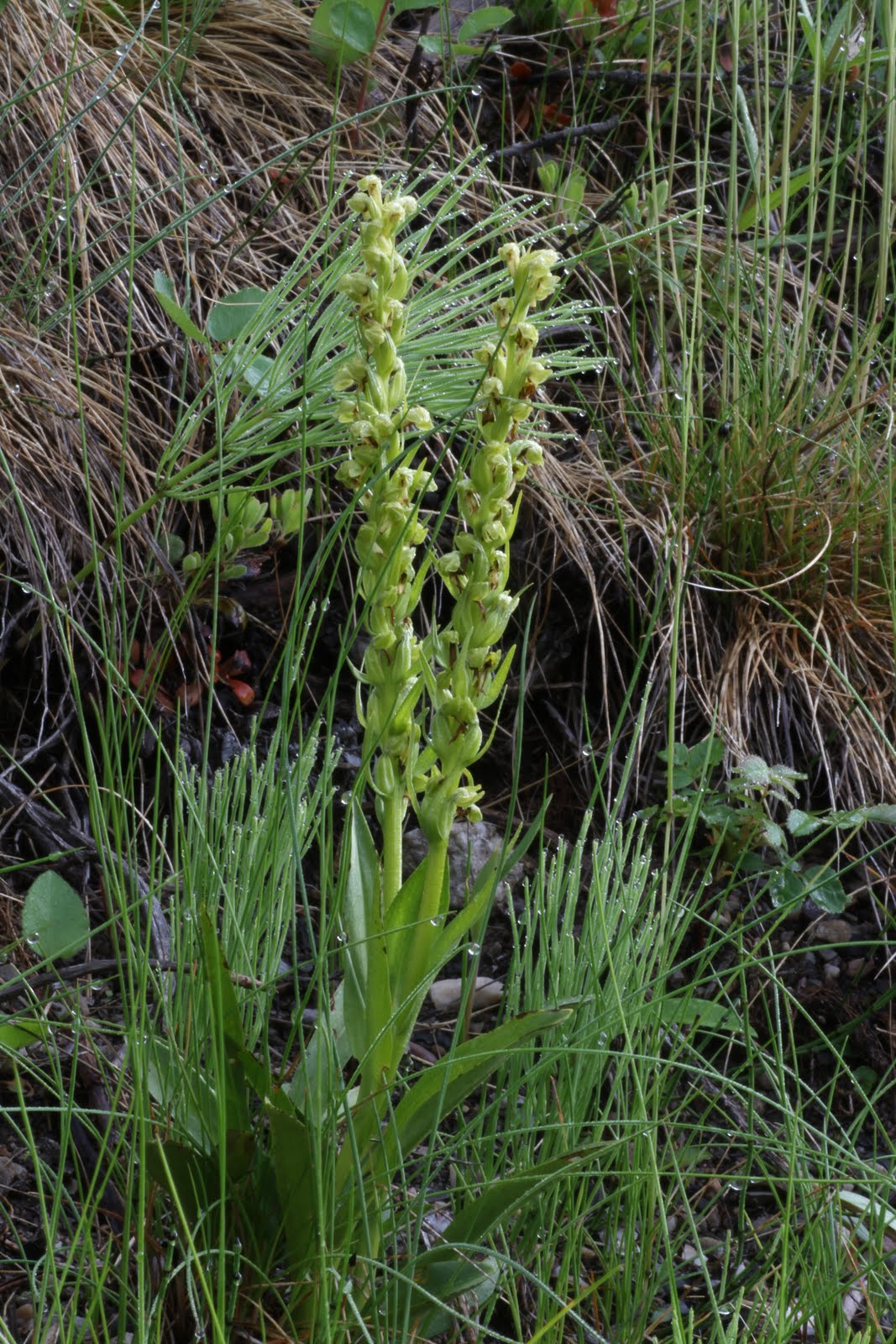
Dactylorhiza viride var. virescens is supposed to be native to Washington but no one seems to know where it can be found.  It is, however, very common in the Canadian Rockies and it is there we see it when we are in British Columbia or Alberta.  It grows to 60 cm tall and the flowers are 2-3 cm in size.  At first glance it looks like one of the green Platantheras but the long, tongue-like lip is distinctive.  It is known both as the Long-bracted Green Orchis and as the Frog Orchid.  There is a smaller variety of the species with fewer flowers and shorter bracts that is found only much further north from Alaska to Newfoundland.

 July 8
(Canadian Rockies)


July 12
(Canadian Rockies)


Thursday, July 29, 2010

Long-bracted Green Orchis (Dactylorhiza viride var. virescens)

The Long-bracted Green Orchis is named for the bracts under each flower which are longer than the flowers and give the flower spikes a rather feathery appearance.  The genus is found around the world in the Northern Hemisphere and has only the one species, though there are several varieties, two of them found in the Pacific Northwest, though one only in very limited alpine areas.


This variety is the more common in North America (the other is found only in Alaska, but is very common in Europe and Asia).  It is considered "rare to local" in the areas where it can be found, but this may be due in part to the fact that unless seen close-up, it resembles many of the green-flowered Platantheras, and when we found it was actually growing among them.


We had stopped along the road to take pictures of a field of Wood Lilies and had seen some Platanthera huronensis and Piperia unalascensis growing nearby.  Only when we looked closely did we notice the Dactylorhizas growing among them.  Interestingly, the other species were found in a wet area at the foot of the bank while the Dactylorhizas tended to grow a little up the bank and drier.

The long distinctively notched lip makes this species immediately recognizable.  The flowers are green and the flower parts form a sort of hood above the lip.  The flowers were quite closely arranged on the spikes and in the case of the plants we saw had about thirty flowers per spike.  The plants were about 10-25 cm in height and the flowers about 1.5 cm long.


The species ranges from Alaska to Newfoundland and south to Washington, New Mexico, Iowa and North Carolina.  We found it in Alberta in Jasper National Park along the Maligne Lake Road in July, though the information we have indicates that the flowers appear to be perfect long after they have been pollinated and that certainly appeared to be case on some flower spikes.

Note (2017): this species has recently been reclassified as Dactylorhiza and the information in the post has been changed accordingly.