Showing posts with label northern twayblade. Show all posts

Tuesday, September 6, 2016

The End of Another Season


Our 2016 native orchid season was considerably abbreviated by a trip to Australia, so we saw only a limited number of the species we usually visit and did not accomplish much of what we had intended for the season.  The high point was finding in Washington a species we had seen elsewhere but not in the state, Listera or Neottia borealis, the Northern Twayblade.  True to its name we found it in the northernmost parts of the state.


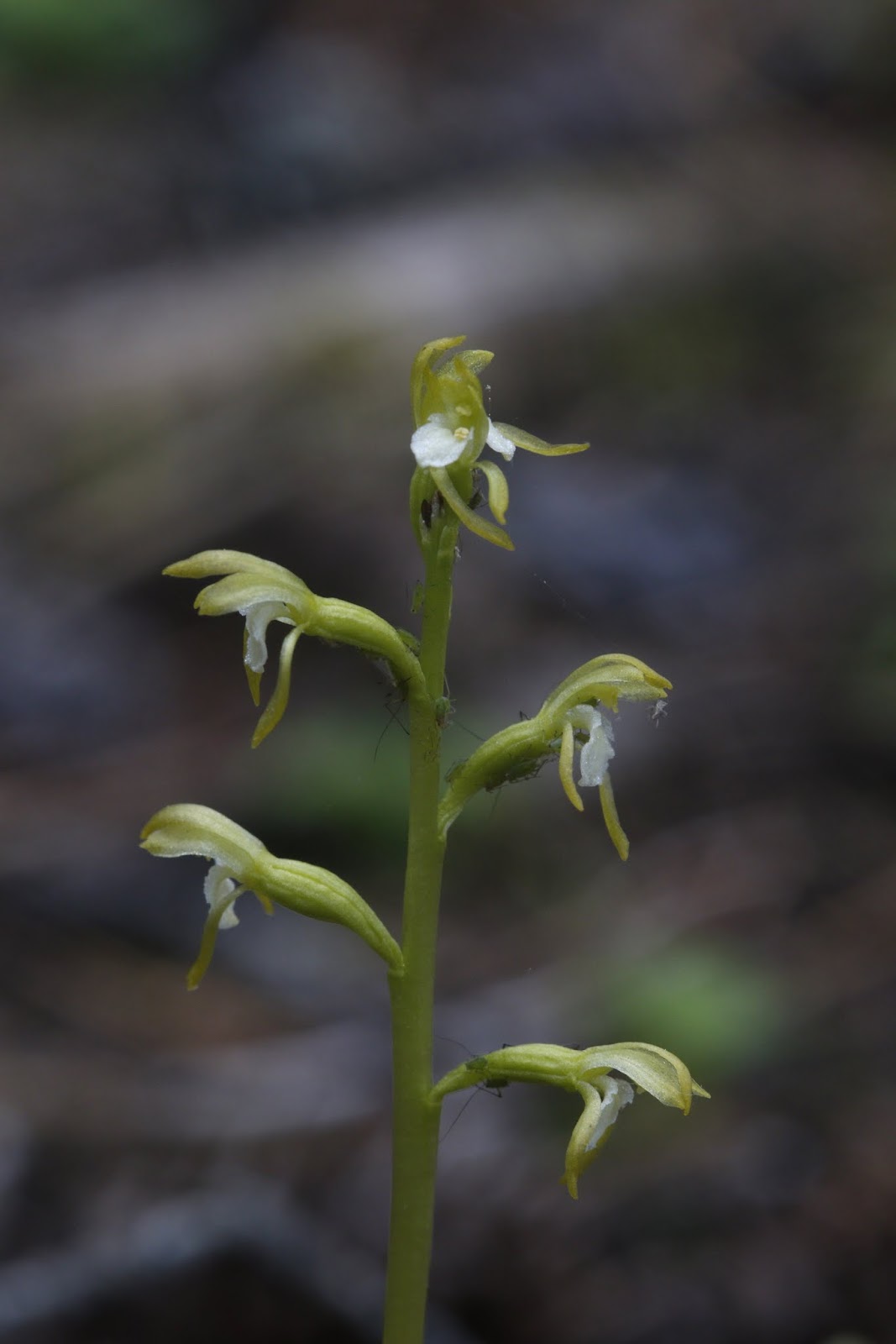
We also looked for and found again some rarities, particularly the natural hybrid of the two varieties of Fairy Slippers, the Eastern and Western Fairy Slippers, Kostiuk's Hybrid Fairy Slipper, Calypso bulbosa x kostiukiae, and the white form of the Western Fairy Slipper, Calypso bulbosa var. occidentalis fma. nivea.  Both of these were growing where we had found them previously and seemed well established in those locations.


We found some new sites for the Western Fairy Slipper and for the Early Coralroot, Corallorhiza trifida, the latter especially important since it is not common in the state of Washington.  These sites were on both sides of the Cascades and proof that the species is adaptable and quite widely distributed, though it is here near the southern end of its range, being much more common as one moves to the north. 


We missed a lot of species, however, and will have to look for some of them next year.  As always are plans are to look for new locations and to find in the state of Washington the species we have not yet seen there, especially Dactylorhiza viride var. virescens, the Long-bracted Green Orchis, and Platanthera obtusata var. obtusata, the Blunt-leaved Rein Orchis, and we have locations for both within the state.

Wednesday, July 6, 2016

Four Orchids in Sherman Pass


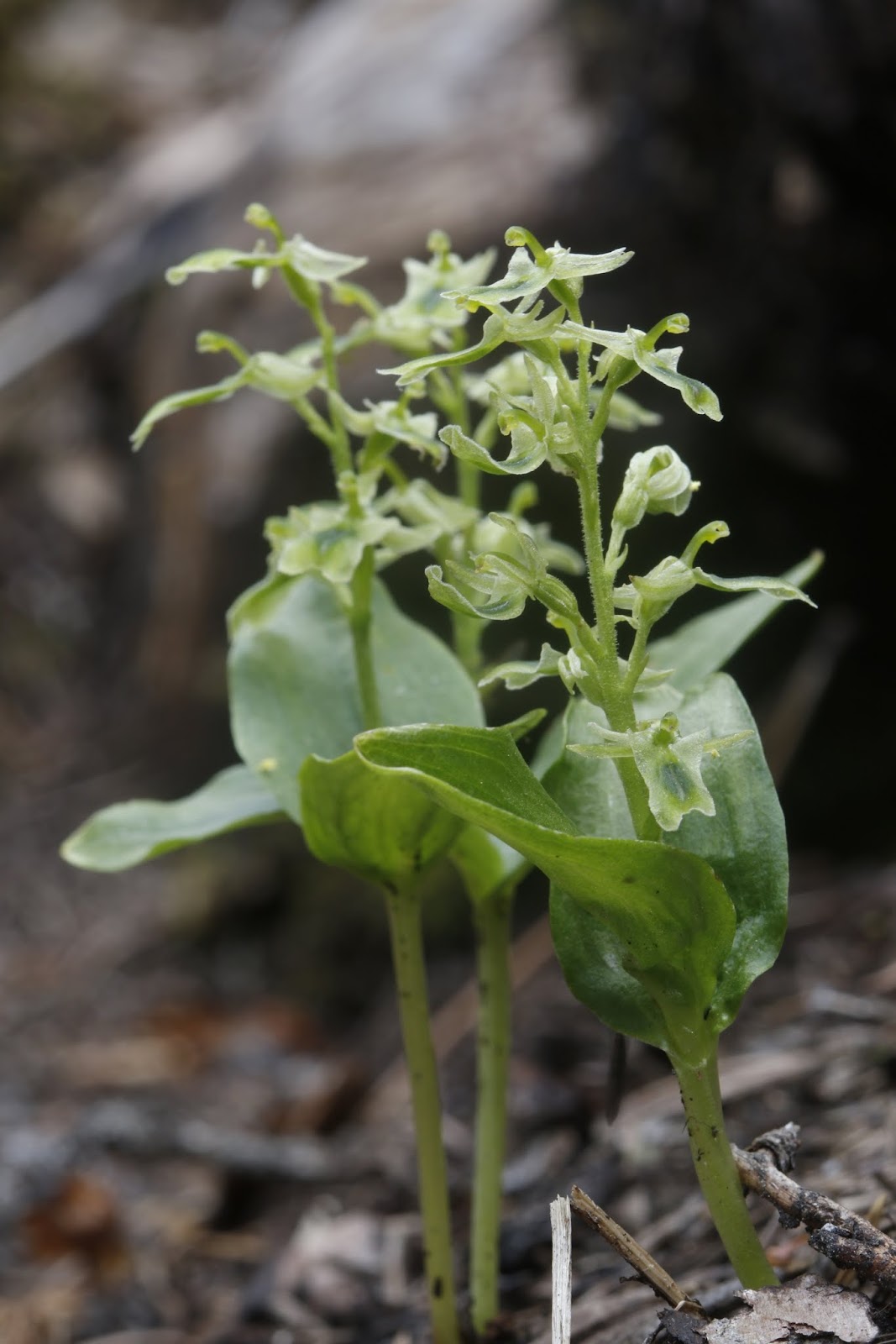
Traveling to eastern Washington, I did some hiking in the area of Sherman Pass in Colville National Forest.  I was looking for the Northern Twayblade, Neottia borealis, a plant I had seen many times in the Canadian Rockies and never here in Washington.  Using GPS coordinates given me by a friend, I found it at the peak of its bloom right along the trail, about a dozen plants and growing with it, the Early Coralroot, Corallorhiza trifida, though that was very nearly finished blooming.  Later, continuing my trip, I stopped along the road to photograph a large colony of the Stream Orchid, Epipactis gigantea, and some Sierra Rein Orchis, Platanthera dilatata var. leucostachys, growing with them.  The star of the show, though, was the Listera, a first for me in Washington.

Northern Twayblade
Neottia borealis


Early Coralroot
 Corallorhiza trifida


Stream Orchid
Epipactis gigantea


Sierra Rein Orchis
Platanthera dilatata var. leucostachys


Wednesday, July 27, 2011

Neottia borealis on the Berg Lake Trail


These native orchids are so small that whenever I am taking pictures of them along the trail someone stops and asks what I'm photographing.  In fact on this hike I missed most of them on the way in and only saw them on the way out when I was keeping a closer watch for them.


The flowers are distinguished by the dark green stripe on the lip, but the plants are less than 15 cm tall and are usually hidden by other vegetation.  They tend to grow in darker locations and are also for that reason somewhat difficult to find and even more difficult to photograph.


Neottia borealis, the Northern Twayblade, grows all along the Berg Lake Trail from very near its beginning up to the shores of Berg Lake and is in bloom over a very long period of time.  I enjoy it but can understand the unenthusiastic response of some.

Monday, November 8, 2010

Northern Twayblade (Neottia borealis)

All the Neottias are small plants with small flowers, but if it is possible to have a favorite among them, this would be mine.  Perhaps that is only because it brings back memories of several fabulous backpacking trips in Mount Robson Provincial Park in British Columbia, but it is nonetheless the species in this genus that stands out in my mind.

The plant is only 10-20 cm tall and the 5-15 flowers, fewer in number than Neottia banksiana, are only about a cm long.  The plant has two and occasionally three leaves opposite each other about midway up the stem and flowers early in the summer, though we have found it well into August at higher elevations, usually as single plants and often growing with Neottia cordata.


The plant, which used to be known as Listera borealis, is found from Alaska all across Canada and in the northwestern United States as far south as Utah and Colorado.  It is reported to be rare and local, but we have found it in fairly large numbers in the Mount Robson area, usually growing in damp shaded areas at the edge of woodlands.  It is very rare in Washington.