Showing posts with label platanthera chorisiana. Show all posts

Thursday, September 10, 2015

Twenty-ninth Orchid of the Season and Others


Chamisso's Orchid, Platanthera chorisiana, is one of our smallest native orchids and very hard to find.  In our area these grow in a boggy area among the sedges and at the edge of the bushes and shrubs.  Both plant and flowers are the same green as the grasses and sedges, too.  When I went to visit them they were finished blooming and so I've also included an older photo of the species.  They were 15 cm tall or less and the tiny flowers are less than 1 cm and do not open widely.  It grows at high elevations or northern latitudes.

Platanthera chorisiana


Growing in the same area were the Sierra Rein Orchis, Platanthera dilatata var. lecostachys, the Slender Bog Orchis, Platanthera stricta, and the Hooded Ladies'-tresses, Spiranthes romanzoffiana.  All of these were nearing the end of their blooming season as well, especially Platanthera stricta.  All of these plants like wet areas and sedge mat where they were found is always wet, but even there they were earlier than normal, due to an early spring, little snowfall in the mountains, and a hot dry summer.

Platanthera dilatata var. leucostachys


Platanthera stricta


Platanthera dilatata var. leucostachys and Platanthera stricta


Spiranthes romanzoffiana


Friday, September 20, 2013

The End of Another Season (2013)


The 2013 native orchid season was very unusual in some ways.  It began very early with a warm wet spring and ended very early with a warm dry summer.  It was good orchid-hunting season for us in our own state, however, with one variety, two species and one natural hybrid seen in Washington for the first time, along with several new locations found for the all-white form of the Western Fairy Slipper and with our first look at the unspotted form of the Western Spotted Coralroot.

On a trip to Canada we saw two new species that we had not seen before, as well as a new variety of the Small Round-leaf Orchis, a very common northern species that is not found in Washington.  All of these are very rare and elusive and we are very thankful to a friend, Ben Rostron, for trusting us enough to take us to see them in their closely guarded locations.  This trip was the high point of the orchid season for us and we hope to make the trip again next year.

The two species that we had not seen before in Washington were Cypripedium parviflorum and the elusive and tiny Platanthera chorisiana.  The former is very rare in Washington and the latter rare throughout its range.  We also saw the natural hybrid of Cypripedium parviflorum and Cypripedium montanum, Cypripedium x columbianum.  Though we had seen this hybrid before we were delighted to find it growing in a mixed population that included both parents.


We also saw for the first time in Washington, the Eastern Fairy Slipper, Calypso bulbosa var. americana.  We had seen this species in British Columbia but not in our state.  In the location where we found it we looked for the natural hybrid of the two varieties of Fairy Slippers, Calypso bulbosa x kostiukiae, but could not find it, another task for next season.  The Eastern Fairy Slipper is notable for its yellow beard and unspotted central lip lobe.


The new species seen in Canada were Liparis loeslii, the Fen Orchis and Malaxis brachypoda, the White Adder's Mouth.  Both of these are rather insignificant and would probably pass unnoticed to the casual observer, but we were delighted to see them for their rarity.  We also saw on this trip Amerorchis rotundifolia fma. lineata, the striped-lip form of the common Small Round-leaf Orchis.  This form is in our opinion even more beautiful than the ordinary form.


We had seen the white form of the Western Fairy Slipper, Calypso bulbosa fma. nivea, once before, but we discovered this spring that that plant had been dug up and stolen.  We found several more locations for it, however, and are keeping the location a closely-guarded secret.  We also found a near-white form with only hints of color, what would probably be called a semi-alba form in the orchid world.  That location, too, we are keeping secret or sharing only with those we trust.


Finally, we were taken by another friend to see the yellow, unspotted form of the Western Spotted Coralroot, Corallorhiza maculata var. occidentalis fma. immaculata, a spectacular plant whose location will also remain undisclosed.  These, with new locations for many other species, with visits to many locations that we had visited before, and with all the other natural beauties we see on these excursions, made for a very profitable and interesting season.


One note: we found through a friend that one species reported from the Pacific Northwest, Wister's Coralroot, Corallorhiza wisteriana is not actually found there.  The original location, so we were informed, was in a garden where it had been transplanted from further east.  That leaves only two species from Washington that we have not seen, Listera convallarioides, the Broad-lipped Twayblade, and Spiranthes diluvialis, the Ute Ladies-tresses.


Monday, September 16, 2013

The Northwest's Green-flowered Platantheras


The green-flowered Platantheras with the exception of the tiny and rare Platanthera chorisiana (Chamiso's Orchid) are very difficult to tell apart and most experts consider them to be a series of species many of which hybridize with one another and thus intergrade.  This is our experience as well.  We have found plants that very closely fit the description of each species, but have also found endless numbers of plants that are very difficult to identify and seem to have characteristics of more than one species.


The species are Platanthera aquilonis, huronensis, sparsiflora and stricta and a number of hybrids, Platanthera x correllii, x estesii and x lassenii, the first a hybrid of Platanthera aquilonis and stricta and the both the latter hybrids of the white-flowered Platanthera dilatata (with P. stricta and P. sparsiflora).  The white-flowered Platanthera dilatata with its three varieties cannot be confused with any of the green-flowered species, but because it hybridizes with them must be considered here also.

Of these species, Platanthera sparsiflora, the Few-Flowered Rein Orchis, is the easiest to identify and the most clearly defined as a species in our experience, though our experience of this species is somewhat limited since it is at the extreme northern limit of its range in Washington.  The narrow flowers, usually widely spaced on tall spikes are the identifying features.  It is found in Oregon, California, Nevada, Utah, Colorado, Arizona and New Mexico and in southern Oregon and northern California often grows in serpentine soils.


This species has a named hybrid with Platanthera dilatata, Platanthera x lassenii, Lassen's Hybrid Rein Orchis, but this is known only from cultivation, at least to my knowledge.  I know of no one who has seen it in the wild or seen anything that might resemble it.  The pictures of it I have seen show a spidery pale green flower that looks a bit like the Platanthera dilatata parent.  There are also several varieties and new species that have been separated from this species, but they are not found in the northwest.

Next is Platanthera aquilonis, the Northern Green Bog Orchis, distinguished by its green flowers with a yellowish lip, a lip that is more or less straight-sided, a club-shaped spur that is curved forward and shorter than the lip, an absence of scent and anther sacs that are low in the flower, widely separated at the base and close together at the top.  The pictures below represent close approximations to the description of this species, but as we shall see there are plants that only partly fit this description and have also characteristics of other species.


Platanthera huronensis, the Green Bog Orchis, can be difficult to distinguish from the previous species.  Though it is ordinarily a whitish-green, the color varies and the two species cannot be distinguished by color alone.  Along with the color, its features are a lip that is not yellowish, a lip that has a dilated or narrowed base, a spur that is not as distinctly thickened as the previous species and that is equal in length to the lip and does not curve forward, with anther sacs toward the top of the flower and almost parallel.


Very similar to this species is the natural hybrid of Platanthera dilatata and stricta, P. x estesii.  In our experience the slender curved spur, and the widened base of the lip, both very much like the spur and lip of the Platanthera dilatata parent are distinctive as well as the whitish color.  This hybrid seems quite common - we have seen it in the Olympics, in Yellowstone National Park and in the Canadian Rockies - and if we have correctly identified it would indicate that the two parents rather freely hybridize with one another.  In all these locations the two parents grow and flower together.


Platanthera stricta, the Slender Bog Orchis, is distinguished by rather small green flowers, a straight-sided lip and a spur described as "scrotiform," i.e. with an inflated tip, a spur that is shorter than the length of the flower.  This species is very common and blooms along-side of and concurrently with the other green-flowered Platantheras.  At first meeting it seems rather easy to identify until one begins to find plants that do not match the description of the species exactly and have characteristics of the other species.


Finally, here are a couple of pictures of flowers that do not clearly fit any of the descriptions.  The first has every characteristic of Platanthera stricta, spur shape and lip shape especially, but has a lip that is very yellow, a characteristic of Platanthera aquilonis and the reason I identified it in the field as the latter species.  The second has all the characteristics of Platanthera stricta, too, except the spur in length and shape is much more like that of Platanthera huronensis.  This would probably be classified as Platanthera stricta but is not completely characteristic of that species.


Monday, July 22, 2013

Thirteenth, Fourteenth and Fifteenth Weeks of the Native Orchid Season - a Few Platantheras, a Non-native and an Elusive Rarity


These three weeks were spent traveling cross-country to a youth camp and to visit family and there were few opportunities for orchid hunting, so I've combined the three weeks and the few orchids we saw into one post.

 June 30-July 6

This week was spent driving to a young people's camp in eastern Washington and then to Yellowstone National Park, followed by a long and hurried drive across country to Michigan and Indiana to see family.  Not much time to go orchid hunting and not many orchids to find except some or Bog Orchids.

Platanthera stricta, the Slender Bog Orchis, was at the peak of its blooming season in the Cascades and I made several stops to photograph them.  This is a rather nondescript species with small green flowers that is so common we do not always even take the time to photograph it.


We also found Platanthera dilatata in the North Cascades and again in Yellowstone National Park.  The variety we found growing in the North Cascades, however, was Platanthera dilatata var. dilatata, distinguished by a spur that is approximately the same length as the lip.


In Yellowstone we found that variety as well as Platanthera dilatata var. leucostachys, distinguished by its very short spur, very much shorter than the lip.  This species is very common wherever it is found and though beautiful and fragrant is another species that we do not always take time to photograph.


In one area, growing with the Bog Candles, Platanthera dilatata var. albiflora, the  were a number of plants of Platanthera huronensis, the Green Bog Orchis.  The two speciers look quite similar but the Green Bog Orchis is different in color and the shape of the lip.


We also found one plant of Spiranthes romanzoffiana, the Hooded Ladies' Tresses, another common Yellowstone species, in bloom near one of the hot springs, probably encouraged to bloom early by the heat of the spring since this species usually does not bloom until August.


 July 7-13

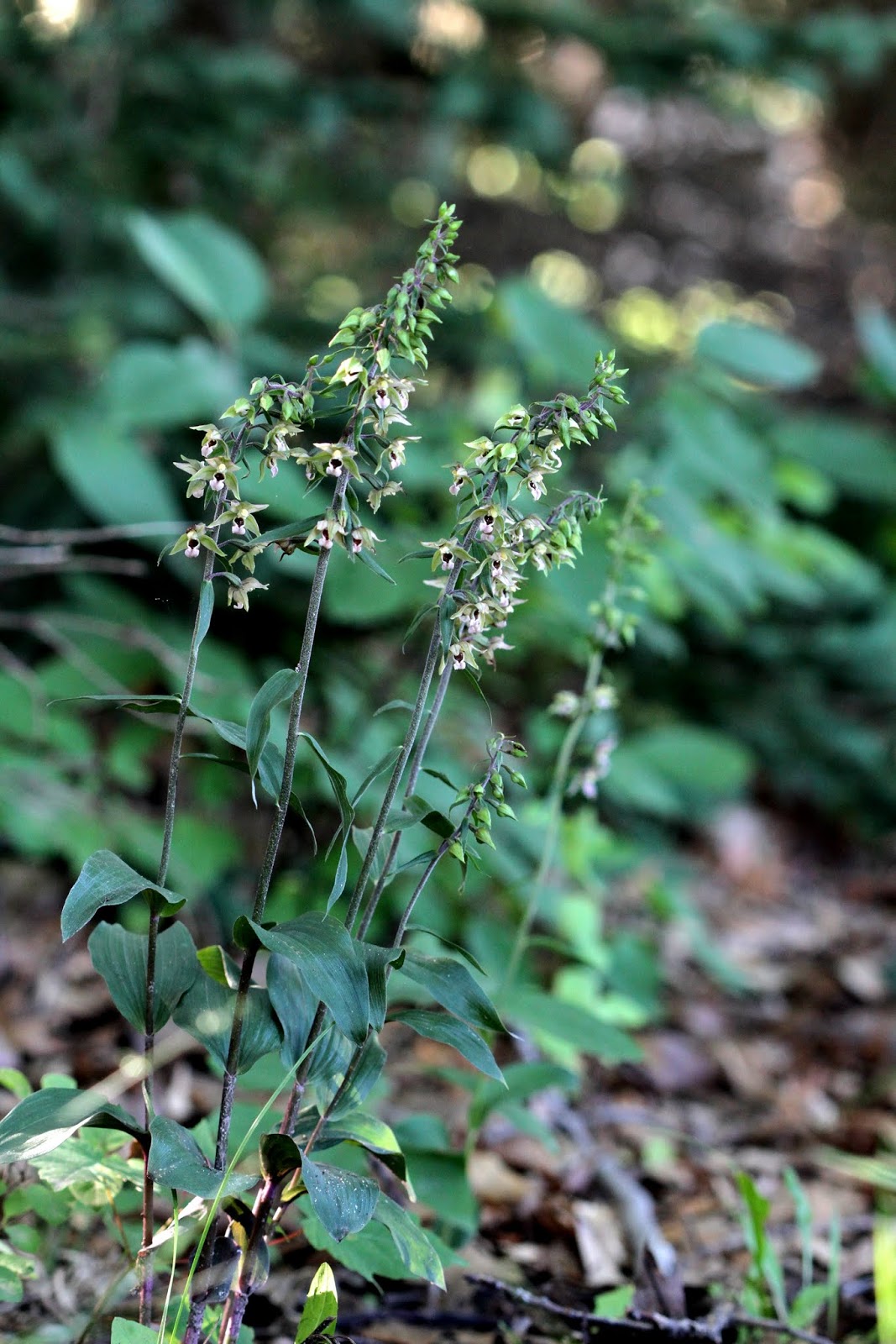
This second week was spent with family including a few days camping on the shores of Lake Michigan.  We found one orchid which seemed to be everywhere in the sandy areas along the lake and which was just starting to bloom, Epipactis helleborine, the Broad-leaved Helleborine.

This orchid is not actually a native, but a European import which has spread across the northern United States and southern Canada and in some areas has the status of a weed.  We have found it here in Washington in several location, but it was even more common is western Michigan.


July 14-20

The first part of this week was spent with family and the latter part of the week driving home, so there was almost no opportunity for orchid hunting.  On the last leg of our trip, however, we caught up with some of the members of the Washington Native Orchid Society for a hike in the Cascades.

A member of Washington Rare Care was along to show us a location for the tiny and rather inconspicuous but rare, Platanthera chorisiana, Chamisso's Orchid.  A long and difficult hike and a lot of bouldering and walking on snow brought us to the location where we found only one plant just blooming.