Showing posts with label alberta. Show all posts

Wednesday, August 24, 2011

Platanthera dilatata in the Canadian Rockies


One of the joys of traveling in the Canadian Rockies from mid-June to mid-July is seeing the Bog Candles, so very aptly named, in every wet location along the highway.  Driving the Yellowhead Highway we began to see them along the road north of Blue River and saw them again along the road from Tete Jaune Cache all the way to Jasper National Park.


They are often growing by the hundreds and even thousands in open boggy areas and their white flower spikes stand out like candles amid the surrounding vegetation.  When one stops to examine them more closely their sweet fragrance is almost overwhelming.  They certainly are one of the attractions of  what is often a long and tiring drive.


We found two varieties on this trip, the short-spurred Platanthera dilatata var. albiflora (below), and the mid-length spurred var. dilatata, the two varieties often growing and blooming together.  The latter is considered to be more common but we found both varieties in abundance.  Neither seemed to be more common than the other, though we made no counts.

Thursday, August 4, 2011

Platanthera huronensis in the Canadian Rockies


Another orchid we found growing with the Bog Candles and Alaskan Piperias along the Yellowhead Highway was the very common and not very exciting Green Bog Orchis, Platanthera huronensis.  In places it was more abundant than the Bog Candles and we even found plants that appeared to be hybrids of this and the Bog Candles.


The flowers on all the plants we saw were very similar, a whitish green with  the sepals and petals forming a kind of hood over the lip.  The plants ranged in size from a 10-15 cm tall to nearly 60 cm.  The flowers were abundant especially on the taller plants, but did not stand out like the white flowers of the Bog Candles.  We took plenty of pictures, however.

Platanthera aquilonis in the Canadian Rockies


Another green-flowered Platanthera, not as common as Platanthera huronensis and slightly more attractive than that species is Platanthera aquilonis, the Northern Green Bog Orchis.  Flowers and plants are very similar, however, and I always have difficulty telling the green-flowered Platantheras apart, though this has also to do with the fact that there are intermediate forms and natural hybrids between the species.  In any case, these are the plants and flowers that I've identified as Platanthera aquilonis.


I've identified these as that species on the basis of the yellowish lip which is more or less lanceolate in shape (lance-head like), and on the basis of the shape of the spur which is pretty much cylindrical.  These characteristics can be seen in the photos which were taken along the Maligne Lake Road in Jasper National Park, Alberta.  These were found growing with Coeloglossum viride and with Wood Lilies (Lilium philadelphicum) in rather wet areas.

Wednesday, July 27, 2011

Platanthera unalascensis in the Canadian Rockies


Traveling along the Yellowhead Highway in British Columbia and Alberta we found this common species of native orchid in various locations, often growing along with other orchids.  In one location it was growing with Platanthera dilatata, the Bog Candle, and in another with Platanthera huronensis, the Green Bog Orchis, and Coeloglossum viride, the Long-bracted Green Orchis.


Though it often grows in large clumps the plants we saw were usually just single spikes.  They are easily identified, however, by their short spurt, many flowers, yellow-green color and small lip.  They were almost always in open sunny locations and areas that were quite wet.  The plant is found all across North America and so it was no surprise to find it here also.

Friday, July 22, 2011

Coeloglossum viride near Maligne Lake


Driving up the Maligne Lake Road in Jasper Park in Alberta watching both for wildlife and for wildflowers, we stopped near a steep bank to take pictures of the Wood Lilies which were especially abundant in that location.  While photographing the lilies and stepping carefully through a rather wet and boggy area we noticed some green flowered native orchids and made sure we identified them also.


They were both plants we had seen earlier in the day and in a number of locations, Platanthera huronensis and Piperia unalascensis.and though we took pictures were not that excited about finding them.  among them, however, was one plant which at first appeared to be another P. unalascensis with flwoers that were going past, though something about them caught my eye.


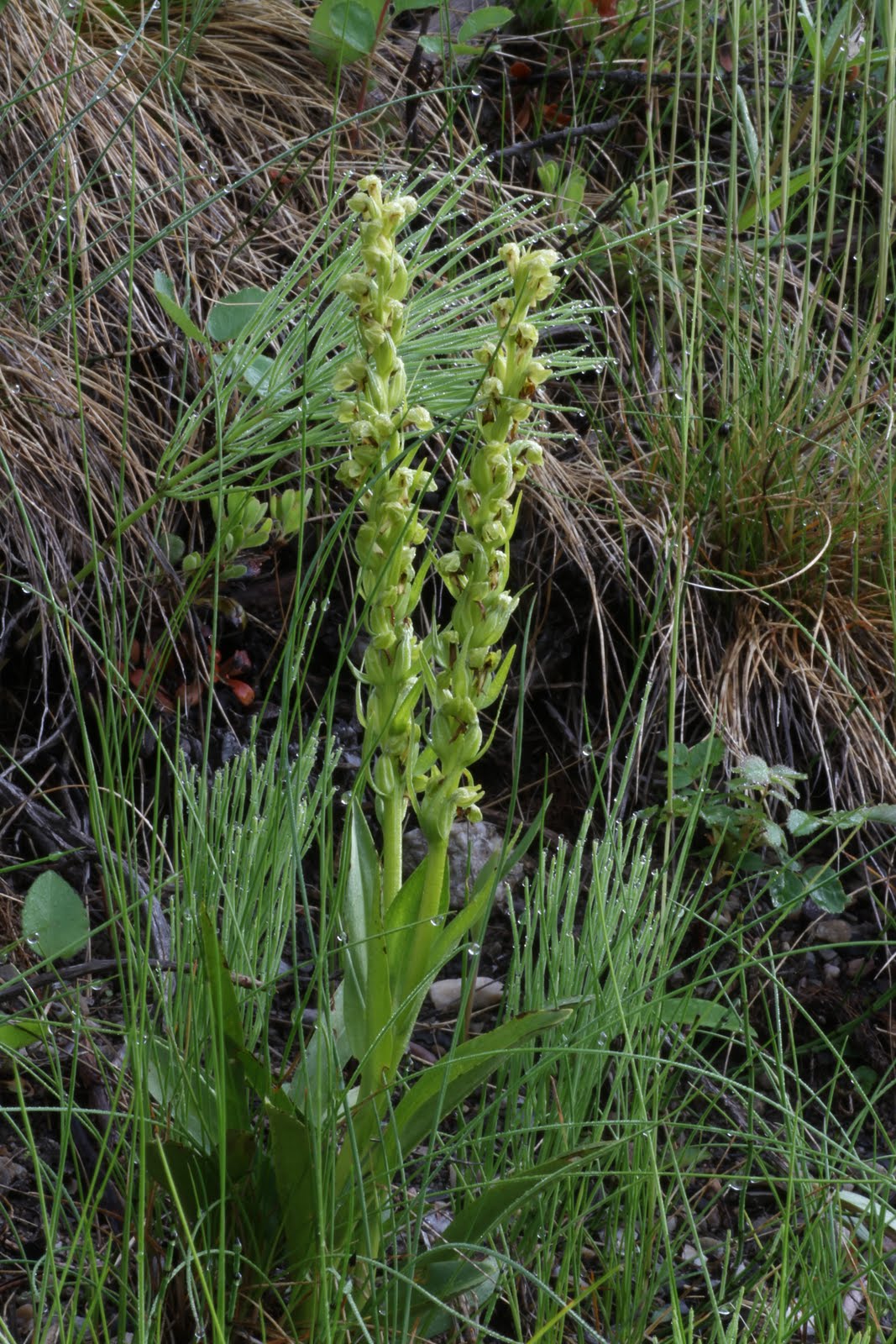
One closer inspection it became clear that they were a native orchid we had not seen before and using our guide we soon identified it as the Long-bracted Green Orchis, Coeloglossum viride var. virescens.  The plants were more of a yellow-green color, the leaves were glossier and the flowers more cupped and crowded on the spike than the other species we had seen.

The most unusual feature and the clue to what these were was the long tongue-like lip with the notch at the end.  On the first spike this lip had turned black on most of the flowers and we still did not realize what we were seeing until we looked at one of the few good flowers under a magnifying glass.  Only then was it really clear that we were seeing something new.


We were quite excited about finding them, and  as as we walked along the bank further up the road began to see more and more of them, most growing up the bank a little ways and some in the shade of the surrounding shrubbery.  In all we found about three dozen plants, some nearly finished flowering and others just beginning to open, but all clearly different from anything else we had seen.


We not only took pictures that evening but drove back up the following morning and took more pictures in the early light with the dew still on the plants.

Saturday, November 20, 2010

White Adder's-mouth (Malaxis brachypoda)

This tiny species is not found in Washington, but is found from Alaska to Newfoundland and in various areas, east and west in the USA.  It's small size may be the reason why it is considered rare in our area.

The plant can be 25 cm tall but is usually much smaller with a single shiny leaf at the base of the plant.  The flowers are greenish-white and are only a few millimeters in size, though numerous (up to 80 per spike).

The two plants we found were 6-8 cm tall and were near a marl pond and in the shade of several trees.  Having found the one plant we did not even notice the second until we got down to take photos.

The species is sometimes considered to be a variety of the Eurasian species, Malaxis monophyllos, but Paul Martin Brown and others make a good case for maintaining it as a separate North American species.


Friday, November 5, 2010

Fen Orchis (Liparis loeselii)

Liparis loeselii, the Fen Orchis or Loesel's Twayblade, is rather widespread in range.  It is found both in Europe and in North America and is reported to be common in the eastern areas of the United States and Canada.  It is rare, however, in the west, having been recently found for the first time in Alberta, where these photos were taken, and with no known locations in Washington, though it has been reported from the state.


It is a small species, not taller than 20 cm and often much shorter with two leaves at the base of the plant and a dozen or fewer flowers about 1 cm in size.  The flowers are pale yellowish-green and grow among sedges and other wetland plants which makes them even more difficult to find.  These were photographed growing in full sun in a very wet fen and were scattered individually over a fairly large area but only in one location in the fen which was very large.


.