June 23-29
What a week this was! Not only did we see a lot of familiar orchid species on our way up to Edmonton (see part 1 of this post), but I managed to get out with Ben Rostron while we were in Edmonton to two natural areas and saw two new species as well as a rare variety of one I had seen many times before. The day with Ben, the subject of this post, was one of the best orchid hunting days I've had in a long time.
The first place we visited was a fen where Liparis loeselii, the Fen Orchis, had recently been found, its first record for Alberta. It is supposed to be native to Washington but I know of no locations in the state and had not seen it before. It also grows in northern Europe and is quite small, the plants 5-20cm and the flowers around 1cm. We found it growing with the Purple Pitcher Plant and other bog plants.
The second place was a natural area that had as many native orchids as we wanted to see, Platanthera huronensis, the Green Bog Orchis, thousands of the Large Yellow Lady's Slipper, Cypripedium parviflorum var. pubescens, the Sparrow's-egg Lady's Slipper, Cypripedium passerinum, and the Western Heart-leaved Twayblade, Listera cordata var. nephrophylla.
Cypripedium parviflorum var. pubescens
Cypripedium passerinum
Listera cordata var. nephrophylla
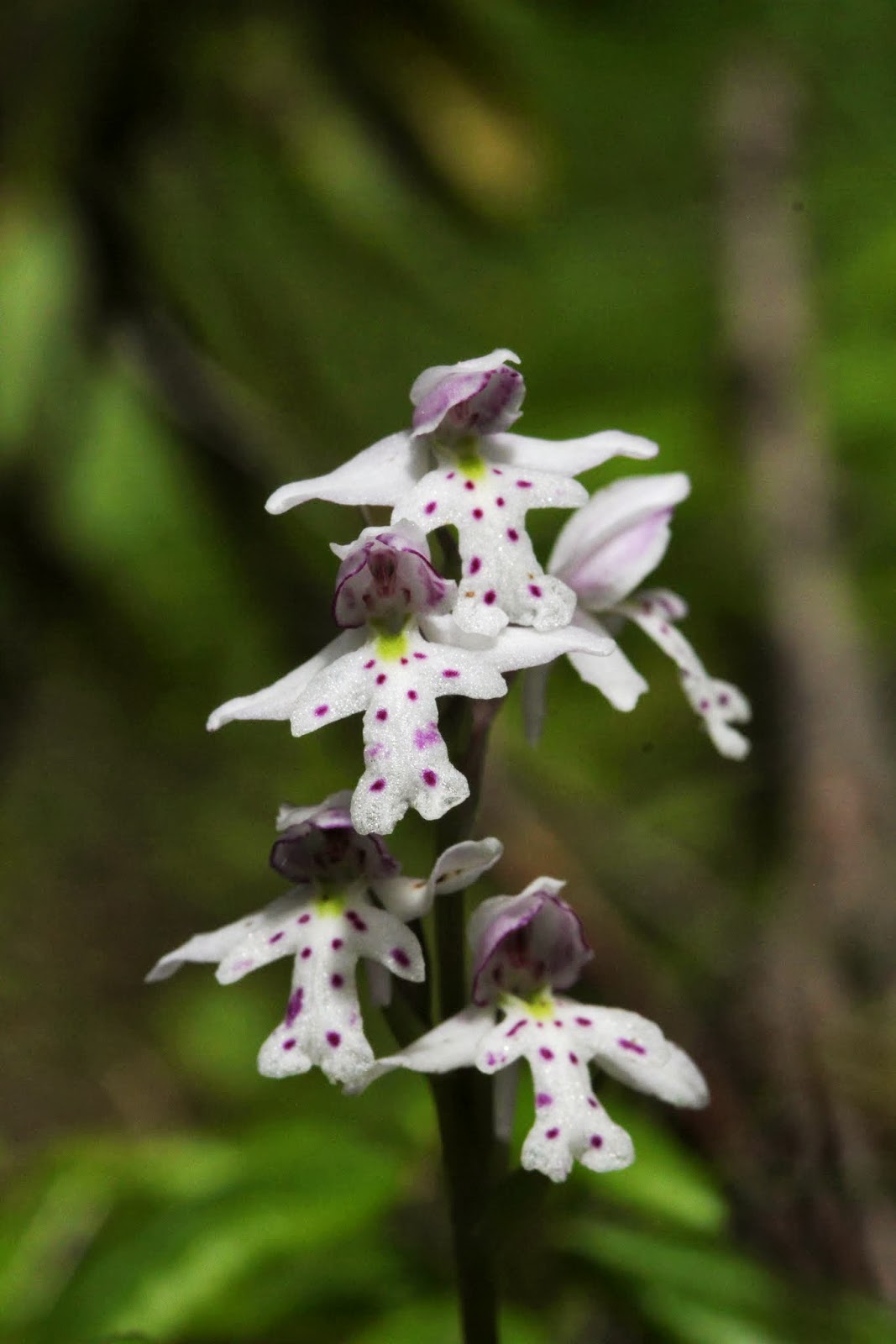
Another orchid we saw there is very common in British Columbia and Alberta, and we saw many of the Small Round-leaf Orchis, Amerorchis rotundifolia, with its tiny bird-like flowers. What was very exciting, though, was finding (with directions from a friend) two plants of the rare lined-lip form, Amerorchis rotundifolia fma. lineata. We looked for the all-white form also but did not find it.
Amerorchis rotundifolia fma. lineata
The real star of the day, however, was the tiny and rare (in the northwest) White Adder's-mouth,
Malaxis brachypoda, or as it is sometimes known,
Malaxis monophyllos var. brachypoda. This species, too, is not found in Washington. We found two plants in flower, one 12cm tall and the other only 5cm with tiny flowers that are 3mm in size, very distinctive with its single shiny leaf.
Notes:
(1) I did not take pictures of the Platanthera huronensis at either of the sites we visited having taken so many pictures of that species on the way to Edmonton. These pictures can be seen in part 1 of this post.
(2) And, Ben, if you see this, thanks again for taking me around.