Showing posts with label whidbey island. Show all posts

Monday, April 25, 2016

More Orchids on Whidbey and Fidalgo Islands


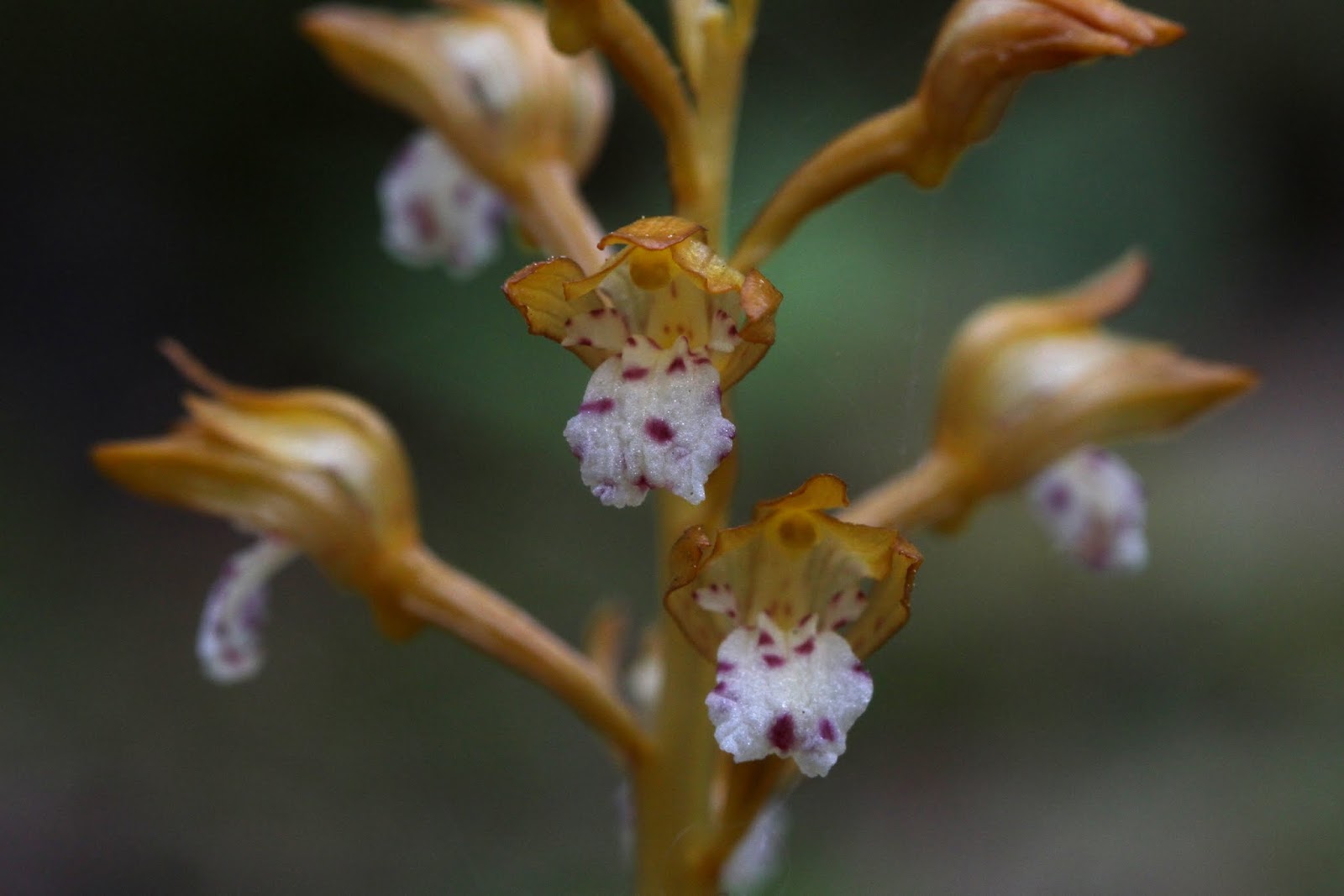
I was out for several hours with members of our local orchid society visiting some of the sites we know on Whidbey and Fidalgo Islandz.  We found three different species and number of rarities including white Fairy Slippers (Calypso bulbosa var. occidentalis fma. nivea) and both the golden-stemmed and the unspotted form of the Western Spotted Coralroot (Corallorhiza maculata var. occidentalis fma. aurea and fma. immaculata).  We also found the dark purple form of the Western Coralroot or Merten's Coralroot (Corallorhiza mertensiana), a form which we know from only one location (this species usually comes in shades of pink, tan, yellow and white).  The Fairy Slippers were nearly finished but the Coralroots were just coming to the peak of their bloom season.  Interestingly, the Fairy Slippers and Western Spotted Coralroots were fewer in number than previous years but the Western Coralroots were much more abundant.

Western Coralroot
Corallorhiza mertensiana


Western Spotted Coralroot
Corallorhiza maculata var. occidentalis


 gold-stemmed Western Spotted Coralroot
Corallorhiza maculata var. occidentalis fma. aurea


unspotted Western Spotted Coralroot
Corallorhiza maculata var. occidentalis fma. immaculata


Western Fairy Slipper
Calypso bulbosa var. occidentalis


white Western Fairy Slipper
Calypso bulbosa var. occidentalis fma. nivea


Monday, June 18, 2012

Western Coralroots at Hoypus Hill


The same day we visited the Au Sable Institute for a second time this season (June 7th) we also visited Hoypus Hill for a second time, looking for the Western Coralroot (Corallorhiza mertensiana) there.  We had found it on our first visit, but it was not in bloom.  This time it was in bloom everywhere.


We found several color varieties, distinguished especially by the color of the stem, though the flowers also vary somewhat in color.  The ordinary variety has stems that vary from a very dark to a lighter reddish purple, but there is a lighter variety (forma pallida) that has stems that are almost white.


We also found one plant of a pale yellow-stemmed variety.  There is no name I know of for this form, but it was very distinctive, though it only had a couple of flowers still blooming.  Interestingly, these color forms grow among each other and apparently interbreed since there are many intermediate shades.


These plants are monotropic and achlorphyllous, that is, they are without chlorophyll and live off decaying material in the soil.  They are often found, therefore, on dark forest floors where little else grows, something I've tried to convey in my photos.

For us that meant that photography was very difficult.  The combination of low light and a slight breeze made it almost impossible to get any depth of field in our pictures and meant, too, that many of the pictures we took were out of focus.  As is often the case, my wife did better than I did under these trying circumstances.

Thursday, June 14, 2012

Two Coralroots at the Au Sable Institute


On June 7th we made a second trip to Whidbey Island and to the Au Sable Institute near Coupeville.  We went to see the Ozette Coralroots (Corallorhiza maculata var. ozettensis) in bloom and found them just starting to bloom, but also found the Spotted Coralroots (Corallorhiza maculata var. maculata) in full bloom.  It was a dark and rainy day and there was a wind blowing as well, so photography was incredibly difficult, but we managed to get good pictures of both species.


The Ozette Coralroot is considered a variety of the Spotted Coralroot though it looks very different and is entirely without spots.  It was first described in 2001 from collections made on the Olympic Peninsula and has been found since in several locations on Whidbey Island and more recently on Vancouver Island and on mainland British Columbia.  It is not endemic to Washington, therefore, as first thought, nor is it as rare as it first appeared to be.  Rare or not, it is very beautiful.

The Spotted Coralroot is found across the United States and Canada and is the least spectacular of all the Coralroots in our area and also, with the similar Western Spotted Coralroot, the most common.  These were blooming in impressive clumps in the woods of the Au Sable Institute and in a few cases they were in the same area as the Ozette Coralroots.  We found them again at Cornet Bay and Hoypus Hill and in Washington Park, but did not take more pictures.


For the first time, as a result of this trip, I have gotten clear in my mind the difference between the Spotted and Western Spotted Coralroots.  I had known that there was a difference in the shape of the lip, the Western Spotted having a lip whose midlobe has rounded sides, in contrast to the Spotted, with its straight sides, but  it was still hard at times to differentiate the two varieties.  This trip showed me that there are other differences as well.


We had made an earlier trip by several weeks to the Au Sable Institute and found the Western Spotted Coralroots blooming.  They were all finished this time, but the ordinary Spotted were in full bloom.  It was evident that the flowers of the latter variety are usually more cupped than the other.  Not just the lip but the shape of the flowers and the bloom times distinguish them, therefore, though unless one sees both varieties in the same location it can still be difficult to tell them apart.