Thursday, November 13, 2014

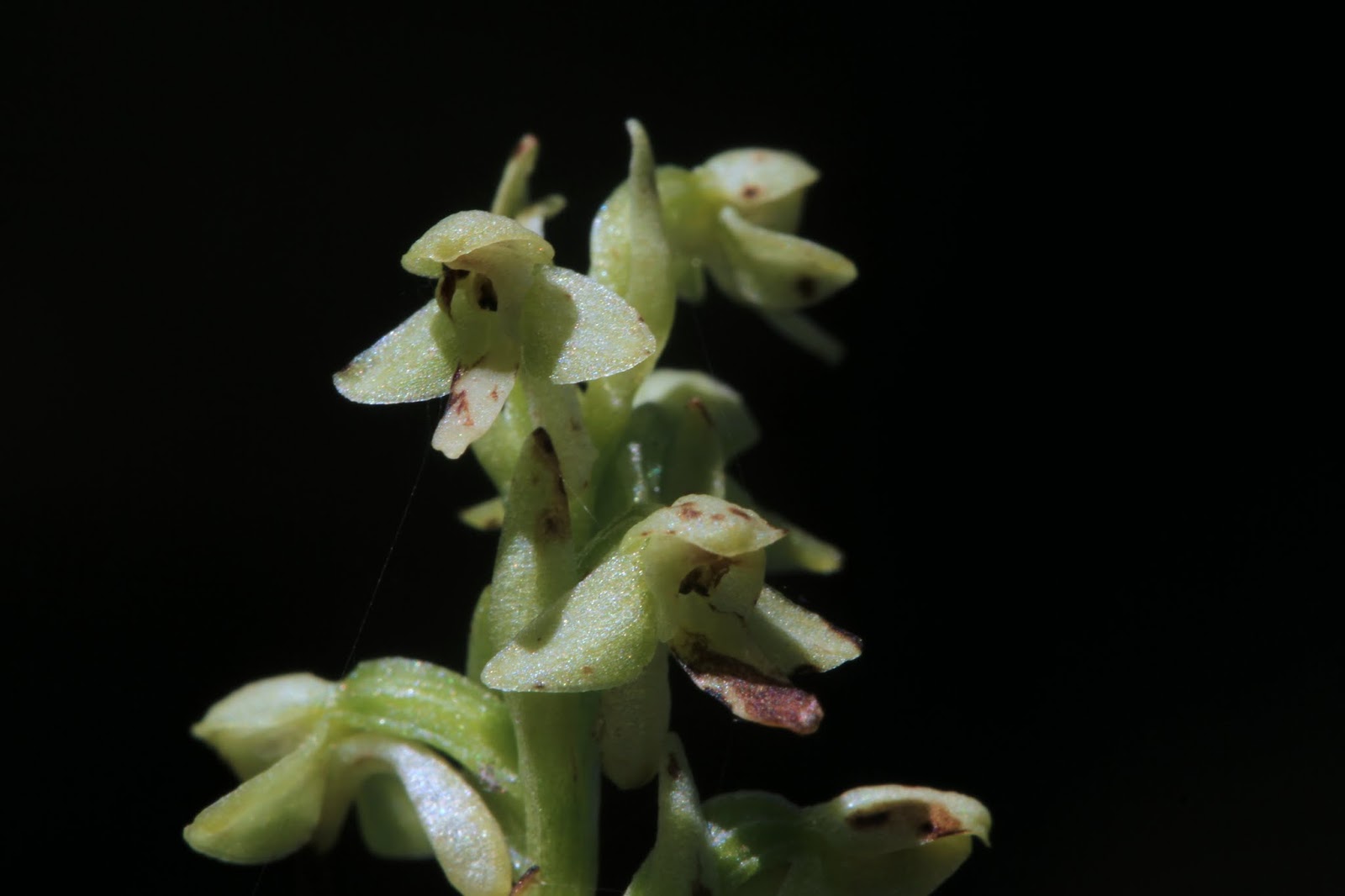
Spiranthes romanzoffiana


Spiranthes romanzoffiana is one of the shorter and more densely-flowered species in the genus. It is supposed to grow as tall as 50 cm, but we very seldom see plants that tall. They are mostly in the 15-30 cm range with some plants little more than a few cm. It is also quite common throughout its range and we have seen it by the thousands in some locations. It prefers wet, sunny areas and blooms in July and August when these areas are often starting to dry out. The flowers are creamy-white to greenish-white and well deserve their common named, Hooded Ladies'-tresses, since the flowers are unique in the genus in that respect. Those flowers are a little over 1 cm in size and have a mild almond scent.

 July 16
(Edmonton, Alberta)


July 31
(North Cascades)


August 2
(North Cascades)


Platanthera stricta


This is, in my opinion, the least attractive of all our native orchids.  It is very common, has tiny green flowers and would pass unnoticed in most cases.  It is found along almost every mountain roadside in wet and boggy areas and apparently interbreeds rather freely with the other green Platantheras and even with the white-flowered Platantheras.  Platanthera stricta, the Slender Bog Orchis, grows to 100 cm or taller, but can be much shorter, can have 50 or more flowers on a spike, but the flowers are 2 cm or less in size and the same green color as the rest of the plant.  It can be identified by its narrow lip and the shape of the spur or nectary, which is scrotiform, that is, has a inflated or bulbous tip.  The spur is always shorter than the lip as well.

July 24
(South Cascades)


July 31
(North Cascades)


Monday, November 10, 2014

Platanthera natual hybrid (?)


While looking for and photographing different Platanthera/Piperia species, I found this oddity which appears to be a natural hybrid between Platanthera transversa, the Flat-spurred Piperia, and Platanthera elegans, the Elegant Piperia, or instead of the latter species, Platanthera elongata, the Long-spurred Piperia.  If it is not a natural hybrid the only other possibility is that it is an odd, short-spurred form of Platanthera transversa.  All three of these species grow in the location I was visiting, though Platanthera elegans only on the other side of the hill where this was found.  The flowers are colored like the flowers of Platanthera transversa, but the spur is not the long, horizontal spur of that species.  The spur looks like that of Platanthera elegans or Platanthera elongata, both of which curve downward, but it is much shorter than the spur of Platanthera elongata.  The plant was growing with other plants of Platanthera transversa.  I've included photos of the three species found in the area for comparison.

July 25
(Whidbey Island)

Piperia transversa

Piperia elegans

Piperia elongata

Monday, November 3, 2014

Platanthera ephemerantha


Platanthera ephemerantha, formerly Piperia candida, is another of the five Platnathera/Piperia species we have in the Pacific Northwest.  It closely resembles Platanthera unalascensis except for the fact that its flowers are white instead of green and therefore also more showy.  Both species have small flowers and a much shorter spur or nectary than the more showy Piperias, but this species is not unattractive.  The plant can be quite tall, over 60 cm, but the flowers are only 3-4 mm, more or less densely packed on the flower spike.  Very often the leaves are withering or have disappeared by the time the plant blooms.  It seems to prefer open dry woodlands and roadside banks.


Platanthera elegans


Platanthera elegans, the Elegant Piperia, is the most beautiful and showy of the five Platanthera species formerly classified as Piperia species that can be found here in Washington and the Pacific Northwest.  It grows to nearly 100 cm tall, though most plants are smaller and has a head of densely packed flowers that, though small (less than 1 cm), put on a good show with up to 80 flowers per stem.  These are often found on dry sunny slopes and the dry summer we had earlier is almost certainly the reason they were in bloom so early.  We found the first in the area of Deception Pass, though only a few of them were blooming yet.

June 24
(Whidbey Island)


July 25
(Whidbey Island)