Monday, May 21, 2012

Coralroots and Twayblades on Whidbey Island


Saturday, May 19th, was a beautiful, sunny day and the two of us, my wife and I, took the day to visit Whidbey Island and several locations on the island that we were acquainted with.  We went first to the Au Sable Institute south of Coupeville and hiked the woods to the east of the Institute, a rather small area but rich in native orchids.  We were looking for two orchids and found five, though one of the five was finished and two were not in bloom yet.

Calypso bulbosa var. occidentalis

Goodyera oblongifolia

Corallorhiza maculata var. ozettensis

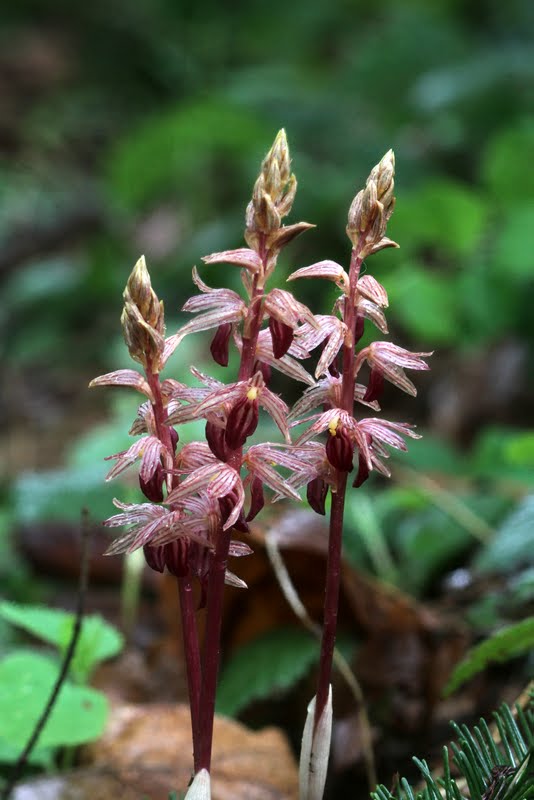
We were looking for the Western Spotted Coralroot, Corallorhiza maculata var. occidentalis and found it at the peak of its season.  We were also looking for the much rarer Ozette Coralroot, Corallorhiza maculata var. ozettensis, but found it a week or two away from blooming.  We also found several Western Fairy Slippers (Calypso bulbosa var. occidentalis)  nearly finished, and we found the Giant Rattlesnake Orchis, Goodyera oblongifolia, months from blooming.


One orchid we did find on the grounds of the Au Sable Institute, that we really were not looking for, was the reddish form of the Western Heart-Leaved Twayblade, Listera cordata var. nephrophylla fma. rubescens.  This plant stands about a foot tall with two heart-shaped opposite leaves halfway up the stem and with tiny insect-like flowers that are only a cm in size.  We found just a couple plants but no doubt would have found more if we had looked harder.


From Coupeville we headed back north to Deception Pass and there went first to Cornet Bay and Hoypus Hill where we hiked some of the trails looking for the Western Coralroot, Corallorhiza mertensiana, which we found, but which was not yet flowering (my wife found one half-opened flower).  There were thousands of them in the woods and we will have to go back in a few weeks.  We saw from the stems that both the ordinary purple form and the yellowish form were present.

Our last stop was Deception Pass where we climbed Goose Rock and explored some of the trails and the balds at the top.  There, too, along the trails we found some nice stands of the Western Spotted Coralroot, in one clump nearly twenty stems, but with a few stems broken due its proximity to the trail.  Photographing was more and more difficult with the breeze that had come up, however, and so we called it a day and headed home.


Friday, May 18, 2012

Two Coralroots at Sehome Hill Arboretum


Wednesday evening, May 16th, after both of us were finished with the day's duties, my wife and I visited Sehome Hill Arboretum in Bellingham.  The 180 acre city park is not a true arboretum but a hill covered with second growth forest that is fairly rich in native flora.  The area is next to the campus of Western Washington University and the University is partly responsible for the park.  It is laced with trails and we spent several pleasant hours there, wandering around and looking for things to photograph.

Western Spotted Coralroot


Among other wildflowers we found three native orchids, a Fairy Slipper (Calypso bulbosa var. occidentalis) that was past its prime, and two Coralroots, the Western Spotted and the Striped Coralroots (Corallorhiza maculata var. occidentalis and Corallorhiza striata var. striata).  The former we found in only one location and there only one spike, the other we found in quite a few locations and in one area around a dozen spikes, all of them fresh and newly opened.

Striped Coralroot


Western Fairy Slippers near Yelm


On Saturday we went on our first excursion of the year with the Washington Native Orchid Society to a location near Yelm to see the Fairy Slippers and other plants.  The location is protected and we had to sign papers agreeing that we would not publish any location information along with our pictures.


The Fairy Slippers here were nearly finished, but we did find some in the woods that were still fresh and worth photographing.  One thing we found was a clump growing on a log, something none of us had seen before.  We figured they had been growing at the base of the tree when it fell and continued to grow there.


In the first of these photos you can clearly see the "bulbs" at the base of the stems, less clearly in the second photo.  These bulbs are often damaged and the plant destroyed if the flower is picked, as happened with hundreds of them in another more public location recently.

The flowers in the second picture are differently colored because they are in different stages of development, the two on the right pollinated and fading.  The brightest flower is the freshest or them all, the other unpollinated flower still a light pink.

Tuesday, May 15, 2012

Striped Coralroots in Larrabee State Park


On May 3rd my wife and I went to see if the Striped Coralroots were blooming in Larrabee State Park.  The day was rainy and very wet, but we went anyway and found them in full bloom, more of them than we had seen before.  The rain actually made for some interesting pictures of this most beautiful of our native Coralroots.


The Striped Coralroot (Corallorhiza striata var. striata) has the largest flowers of any of our native Coralroots and is also the most beautiful, though far more difficult to find than the Spotted or Western Coralroot.  We have found it in only two locations though we know of a few others, but the Spotted and Western Coralroots are everywhere.

Monday, April 30, 2012

Western Fairy Slipper (White-flowered Form) in Washington Park


I have been looking for this and hoping to find it for three or four years and finally have seen it, though I can't take credit for finding it.  A friend from Montana was in our area for the tulip festival and visited Washington Park in Anacortes.  She found it and gave us careful directions as to where she had seen it.  It was growing as a single plant in an area where there were quite a few of the normal form.

This is Calypso bulbosa var. occidentalis fma. nivea, the pure white form of the Western Fairy Slipper.  It lacks all the pink-purple color of the normal form and the lip entirely lacks the brown markings, though there is some yellow-green color at the back of the lip.  In the pictures it is evident that it was a wet and rainy day when we went to see it and we came home very wet and muddy, but happy.


Monday, April 23, 2012

Western Fairy Slippers in Washington Park


On Friday, April 20, we took the afternoon and evening off and went to Washington Park near Anacortes, one of our favorite places.  We went to see the Fairy Slippers, expecting that they would be just starting bloom on account of our long cold and wet spring.  We found them at their peak with some of them already starting to go by.  We did not go only to see them, but to see the Oregon Fawn Lilies (Erythronium oregonum), the Few-flowered Shooting Stars (Dodecatheon pulchellum), and other wild flowers which bloom on the cliffs of this beautiful park.  The Fairy Slippers are the main attraction, though, and spring would not be the same without the opportunity to see them.


We saw the other wildflowers in abundance - the Fawn Lilies nearing the end of their brief blooming season, and the Shooting Stars by the thousands at Green Point, but we had come to see the Fairy Slippers and spent most of our time looking for them and photographing them, often lying on the ground or being discovered in some other strange position when others came past.  The Fairy Slippers on this side of the mountains are all the rarer Western variety with a white rather than a yellow beard, Calypso bulbosa var. occidentalis.  We usually found them scattered as single flowers, but in one location found clumps of three to five of them.


Note: for more pictures of the park and its wildflowers, see the following blog posts:
http://ronaldhanko-orchidhunter.blogspot.com/2011/07/washington-park.html
http://ronaldhanko-orchidhunter.blogspot.com/2011/05/washington-park-again.html
http://ronaldhanko-orchidhunter.blogspot.com/2011/04/first-native-orchids-of-year.html
http://ronaldhanko-orchidhunter.blogspot.com/2011/04/washington-park-anacortes.html